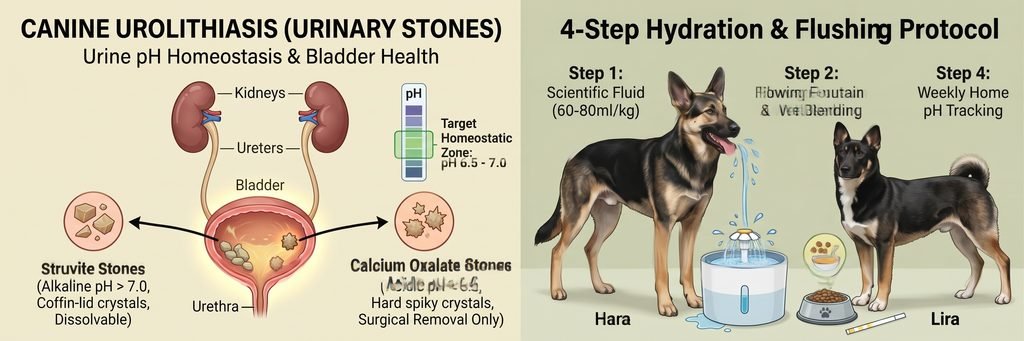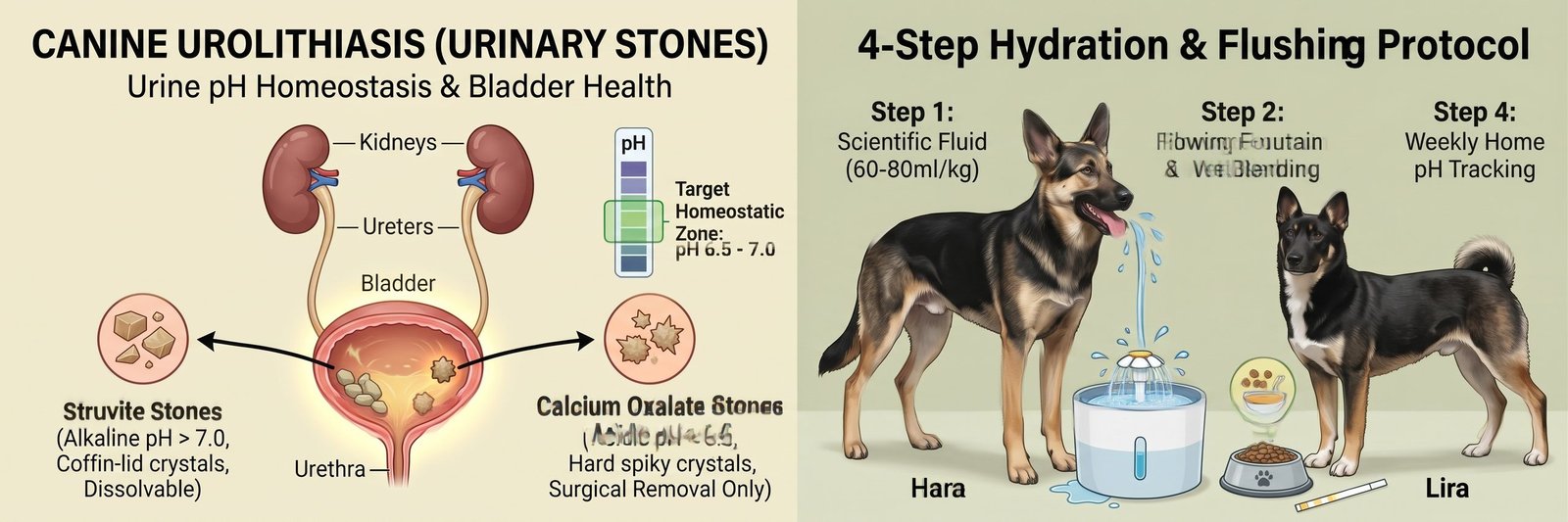
Canine urinary stones (urolithiasis) represent an excruciating, highly recurrent urological crisis caused by the pathological precipitation and aggregation of macroscopic mineral crystals within the renal pelvis, bladder, or urethral tract. Pet owners frequently misinterpret frequent squatting, stranguria (straining to urinate), or pollakiuria as behavioral territory-marking or emotional distress, missing the critical window for medical resolution. As rigid mineral stones abrade the highly vascularized transitional epithelium of the urinary bladder, capillary rupture triggers visible hematuria. Left unmitigated, migrating uroliths can completely obstruct the narrow urethral lumen—a critical veterinary emergency causing acute post-renal azotemia, hyperkalemic cardiac arrest, and bladder rupture within 24 to 48 hours. For high-drive, outdoor-focused German Shepherd crosses (typified by Hara) that voluntarily hold urine during long rest periods, and environmentally alert Shiba crosses (typified by Lira) vulnerable to fluctuations in water intake, strict biochemical regulation of urinary pH and daily hydration volume serves as the definitive physiological shield against stone formation.
Pathophysiology of Canine Urolithiasis: The Dueling pH Micro-Environments
Effective stone prevention hinges on determining crystal mineralogy, as the biochemical environments driving the two most prevalent uroliths are diametrically opposed.
1. Infection-Induced Magnesium Ammonium Phosphate (Struvite) in Alkaline Urine
- Bacterial Urease Synthesis: Ascending urinary tract infections, predominantly driven by urease-producing bacteria such as Staphylococcus pseudintermedius and Proteus mirabilis, hydrolyze physiological urea into free ammonia and carbonic acid.
- Triple-Phosphate Crystallization: This metabolic enzymatic cascade rapidly drives urinary pH upward ($\text{pH} > 7.0\sim 7.5$). Under alkaline conditions, dissolved trivalent phosphate ions rapidly bind with ubiquitous magnesium and ammonium ions, exceeding the thermodynamic solubility product and precipitating into prismatic “coffin-lid” struvite crystals. Fortunately, non-obstructive struvites can be medically dissolved without surgery through strict acidifying therapeutic diets and culture-directed antibiotic regimens.
2. Sterile Calcium Oxalate (CaOx) in Acidic Environments
- Hypercalciuria and Metabolic Acidity: When dietary protein excess, genetic predisposition, or systemic dehydration consistently acidifies urine ($\text{pH} < 6.5$), calcium and oxalic acid ions aggregate into hard, insoluble monohydrate or dihydrate lattice structures.
- Absence of Medical Dissolution (Surgical Excision Mandatory): Unlike struvite stones, calcium oxalate uroliths cannot be chemically dissolved through nutritional manipulation or pharmaceuticals. Once formed, surgical cystotomy, percutaneous cystolithotomy, or endoscopic laser lithotripsy remains the sole corrective avenue, carrying a frustrating post-operative recurrence rate exceeding 50% within 24 to 36 months.
Comparative Matrix: Struvite vs. Calcium Oxalate Uroliths
Preventive management requires precise manipulation of urinary relative supersaturation (RSS) rather than indiscriminate dietary restriction.
| Clinical Parameter | Struvite (Magnesium Ammonium Phosphate) | Calcium Oxalate (CaOx) | Veterinary Action Standard |
| Pathogenic Urinary pH | Alkaline ($\text{pH} \ge 7.0\sim 7.5$) | Acidic ($\text{pH} \le 6.0\sim 6.5$) | Optimal target homeostatic zone: $\text{pH } 6.5\sim 7.0$ |
| Primary Etiology | Urease-producing bacterial UTI (Female predisposition) | Idiopathic hypercalciuria, dehydration (Male predisposition) | Urine culture & sensitivity + serum biochem panel |
| Medical Dissolution Potential | Feasible (Calculolytic acidifying diet, 6–12 weeks) | Zero (Insoluble) (Surgical intervention required) | Serial orthogonal radiography and ultrasound scans |
| Nutritional Countermeasures | Controlled protein/Mg/P + urinary acidification | Controlled oxalate/sodium + urinary alkalinization | High-moisture formulation with strict electrolyte balance |
| Daily Fluid Target | Minimum 60–70 ml / kg body weight | Minimum 70–80 ml / kg body weight | Maintain targeted urine specific gravity (USG) $< 1.020$ |
Veterinary Urology Emergency Alert (Urethral Blockage): If a male canine repeatedly postured to urinate with zero urine output, displays lumbar vocalization upon abdominal palpation, or develops a hard, distended bladder, immediately seek emergency catheterization. Intractable post-renal obstruction precipitates fatal cardiac arrest secondary to acute hyperkalemia within 48 hours.
The 4-Step Scientific Hydration & Flushing Protocol
A targeted clinical protocol engineered to dilute urinary solute concentrations, suppress mineral crystallization, and flush anatomical dead zones.
- Targeted Mathematical Hydration Formula: Canines with a history of crystalluria require an enforced fluid volume roughly 50% greater than standard maintenance rates. Administer 60 to 80 ml of water per kilogram of body weight daily. For athletic 20 kg Shepherd crosses (Hara archetype), target a mandatory minimum intake of 1,400 ml daily; for 10 kg Shiba crosses (Lira archetype), ensure at least 700 ml daily. Diluting the urinary filtrate suppresses the initial nucleation phase of crystal formation.
- Kinetic Hydro-Enrichment and Moisture Infusion (Acoustic & Wet Feeding): Canines naturally reject stagnant, room-temperature water. Introduce recirculating stainless-steel pet fountains to stimulate consumption via auditory and visual running-water cues. Concurrently, eradicate dry kibble feeding; soak dry kibble in lukewarm broth or transition at least 30% to 50% of the daily caloric intake to veterinary-grade wet canned formulas to ensure continuous passive hydration.
- Enforced Bladder Emptying Frequency: Prolonged urine retention in the bladder exponentially accelerates mineral precipitation and bacterial colonization. For dogs conditioned solely to eliminate outdoors, provide a minimum of 3 to 4 scheduled outdoor relief walks daily, never allowing urine to stagnate past 6 hours. For indoor dogs, replace soiled pads immediately to eliminate behavioral inhibition of urination.
- Home Urinalysis and pH Dipstick Tracking: Between formal veterinary rechecks, assess the dog’s early morning voided urine once or twice weekly using medical-grade reagent strips. Verify that dogs recovering from struvites stay within the mild acidic window ($\text{pH } 6.5\sim 6.8$), while those prone to oxalates remain near neutral ($\text{pH } 7.0\sim 7.2$). Abrupt shifts warrant immediate dietary caloric or water volume calibration.
Frequently Asked Questions (FAQ)
Q1. Can I give my dog commercial bottled mineral water to promote hydration?
No. Bottled spring water or tap water derived from hard ground sources contains elevated levels of magnesium, calcium, and fluoride ions. High exogenous mineral loads saturate the urinary filtrate, directly accelerating stone aggregation. The safest source is reverse-osmosis filtered water or pre-boiled, cooled municipal tap water delivered at room temperature.
Q2. My dog’s bloody urine resolved after a course of antibiotics. Do I still need an ultrasound?
Yes. Antibiotic therapy frequently clears superficial bacterial cystitis, alleviating gross hematuria; however, nidus uroliths anchored within the bladder lumen will continuously shelter latent bacterial biofilms. Once antimicrobial therapy ceases, the infection rapidly recurs. Direct orthogonal radiography and high-frequency ultrasound imaging are non-negotiable to visually confirm the absence of radiopaque or radiolucent stones.
Q3. Does my dog have to stay on a specialized prescription diet permanently?
For calcium oxalate formers or dogs with systemic metabolic hypercalciuria, lifelong adherence to a moisture-rich urinary therapeutic diet is imperative to suppress rapid post-surgical recurrence. Conversely, calculolytic diets designed for struvite dissolution are heavily acidified and depleted of protein; feeding them beyond 3 to 6 months can paradoxically induce calcium oxalate crystallization. Always titrate back to a preventative maintenance diet under ongoing urinalysis guidance.
Canine urolithiasis is not a momentary surgical event, but a lifelong metabolic continuum requiring systemic hydration control and dynamic urine pH balance. Lower the mineral concentration, open abundant water pathways, and protect your dog’s vitality and urinary comfort.
- Meta Description: Understand the pathophysiology of canine urinary stones across acidic and alkaline urine pH. Master struvite vs oxalate staging and a 4-step hydration protocol.