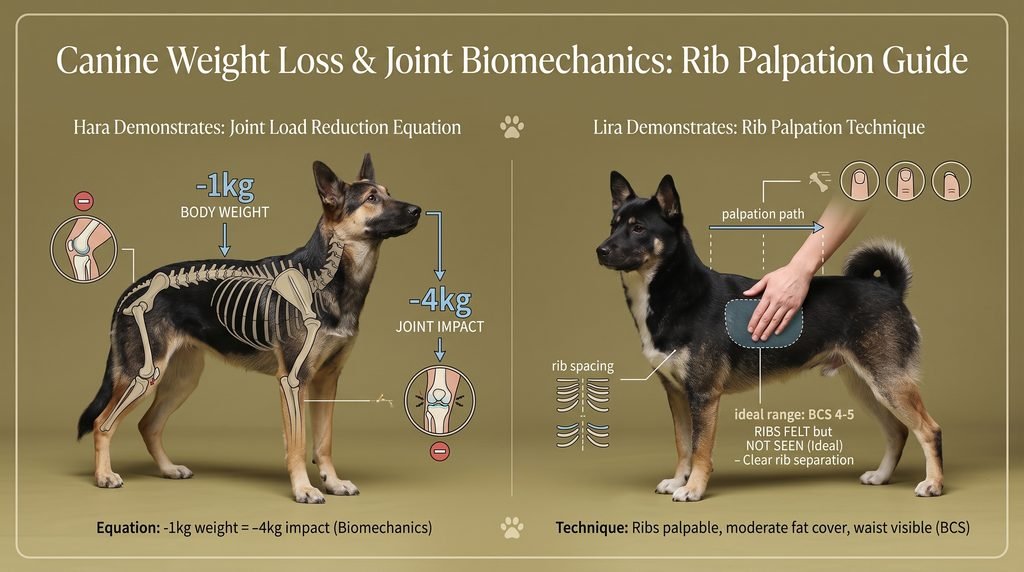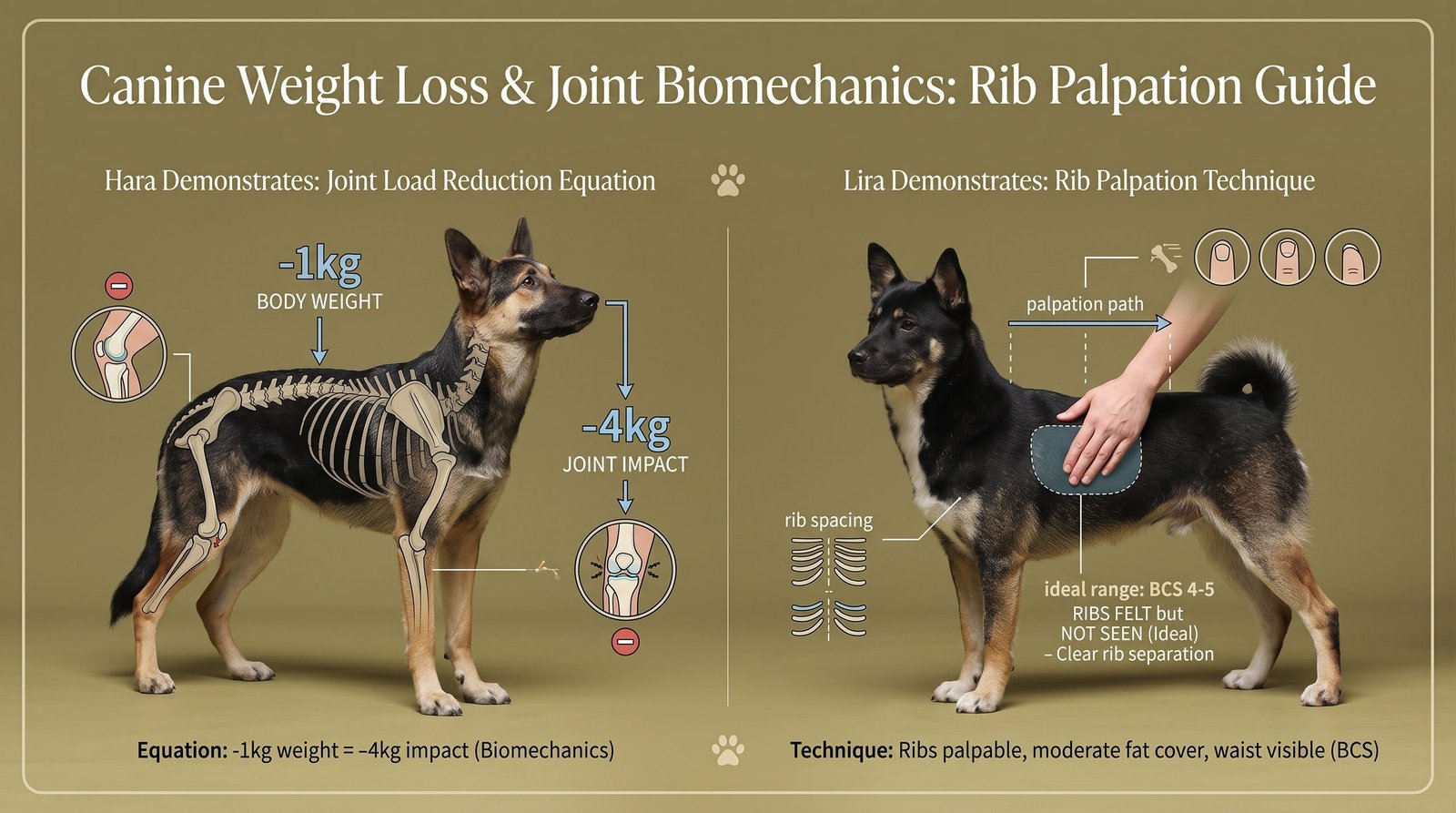
Optimizing canine weight loss joint health is essential to reducing dynamic impact on canine cartilage. When a dog gains just a single kilogram, the mechanical burden transferred to its musculoskeletal system is amplified exponentially. According to veterinary gait biomechanics, a dog absorbs between 3 to 4 times its static body weight in Ground Reaction Force (GRF) with every single step. Consequently, shedding just 1 kg eliminates 3 to 4 kg of dynamic compressive impact across the stifles (knees) and hip joints.
Relying solely on standard bathroom scales frequently misleads owners by masking muscular atrophy as fat loss. By applying the veterinary Body Condition Score (BCS) methodology via structured rib palpation at home, you can safeguard your dog against osteoarthritic progression and extend functional mobility into their senior years.
1. Ground Reaction Force and Joint Wear: The Physics of Canine Weight Loss
Dynamic Amplification of Orthopedic Load
Under standard trotting conditions, a dog distributes approximately 60% of its total body weight across the forelimbs and 40% across the hindlimbs. During sharp directional turns, jumps, or descending slopes, the kinetic shock sustained by articular cartilage spikes to 300%–400% of static body weight.
Veterinary Biomechanics Insight:
For a 15 kg dog taking 3,000 steps daily, shedding just 1 kg removes dozens of tons of cumulative mechanical stress per week. This mechanical decompression slows articular cartilage degradation and lowers reliance on chronic pharmaceutical interventions such as NSAIDs.
Adipose Tissue as an Active Endocrine Disruptor
Adipose tissue is not metabolically inert padding; it acts as an endocrine organ. Hypertrophied adipocytes continuously secrete pro-inflammatory adipokines, Interleukin-6 (IL-6), and Tumor Necrosis Factor-alpha (TNF-α) into systemic circulation. This persistent low-grade systemic inflammation accelerates the enzymatic destruction of proteoglycans in synovial fluid, directly intensifying joint degradation.
2. The Rib Palpation Self-Assessment Protocol for Joint Health
Because standard weight scales cannot differentiate between lean muscle mass and visceral fat, hands-on rib palpation remains the clinical gold standard for nutritional evaluation.
(Image Alt Text: canine weight loss joint health rib palpation test)
The Knuckle-to-Palm Tactile Test
- Back of the Hand = Ideal Condition (BCS 4–5): Run fingers over the back of an open hand. Ribs are clearly palpable under a slight cushion of subcutaneous tissue with minimal pressure.
- Palm of the Hand = Overweight / Obese (BCS 6–8): Press into the fleshy base of the thumb. Substantial pressure is required to feel any underlying skeletal structure.
- Closed Knuckles = Underweight (BCS 1–3): Clench a fist and feel the prominent ridges. Ribs and dorsal spinous processes protrude with zero protective fat padding.
Step-by-Step Tactile Examination
- Four-Legged Stance: Ensure the dog stands squarely on a level, non-slip surface. Sitting or lying down artificially alters thoracic tension and abdominal positioning.
- Lateral Thoracic Sweep: Place flat palms on the lateral ribcage directly caudal to the elbows and glide smoothly backward toward the lumbar spine.
- Fat Layer Resistance Check: Evaluate whether rib contours are easily distinguishable beneath a light glide, or if your fingers depress into a thick subcutaneous fat layer.
- Abdominal Tuck and Waistline Inspection: View the dog from above to check for an inward hourglass contour behind the ribcage, then evaluate the profile to confirm a clear upward abdominal tuck.
3. Canine Body Condition Scoring (9-Point BCS Matrix)
Use this standardized matrix to calibrate caloric intake and track canine weight loss and joint health markers accurately:
| BCS Level | Classification | Palpation Feedback | Visual Biomarkers | Corrective Protocol |
| 1–3 | Underweight | Ribs felt with zero fat covering; sharp bony edges prominent | Deep skeletal prominence, severe abdominal tuck | Increase caloric density; evaluate metabolic status |
| 4–5 | Ideal Target | Ribs easily felt under a thin layer of fat; minimal pressure | Obvious waistline from above, clear upward abdominal tuck | Maintain baseline nutrition (Gold Standard) |
| 6–7 | Overweight | Moderate-to-firm pressure required to discern individual ribs | Waistline faint or absent; horizontal abdominal profile | Reduce daily calories by 15%; introduce slow-feeders |
| 8–9 | Obese | Ribs unpalpable under heavy fat layer; spinal ridge obscured | Rounded barrel torso, fat deposits at neck and tail base | Transition to therapeutic satiety diet under veterinary guidance |
4. Joint-Safe Weight Management Directives
- Target 1–2% Body Mass Reduction Weekly: For a 20 kg dog, target fat reduction is 200–400 g per week. Extreme caloric restriction triggers muscle catabolism, destabilizing joints that depend on muscular support.
- Eliminate High-Impact Concussive Play: Stop high-torque ball chasing and steep grade descents. Structured, flat-surface leash walking for 20 minutes twice daily builds periarticular stabilization without concussive impact. For targeted joint protection routines, explore our comprehensive canine joint care and exercise guide.
- Enforce the 10% Treat Caloric Cap: Ensure 90% of daily intake comes from complete and balanced veterinary diets. Swap processed treats for low-glycemic, fiber-rich alternatives such as raw green beans or steamed zucchini to promote satiety.
Frequently Asked Questions (FAQ)
Can joint supplements replace the need for weight loss?
No. Chondroprotective compounds like glucosamine, chondroitin, and omega-3 fatty acids support cartilage matrix metabolism, but they cannot mechanically counter 300%–400% body weight in dynamic ground reaction forces. Caloric control remains the primary clinical therapy for canine osteoarthritis.
How do I accurately evaluate double-coated breeds using BCS?
Dense undercoats render visual appraisal ineffective. You must manually part the coat and apply firm downward pressure directly against the ribcage wall. Hands-on rib palpation is the only method to establish an accurate Body Condition Score in heavy-coated dogs.