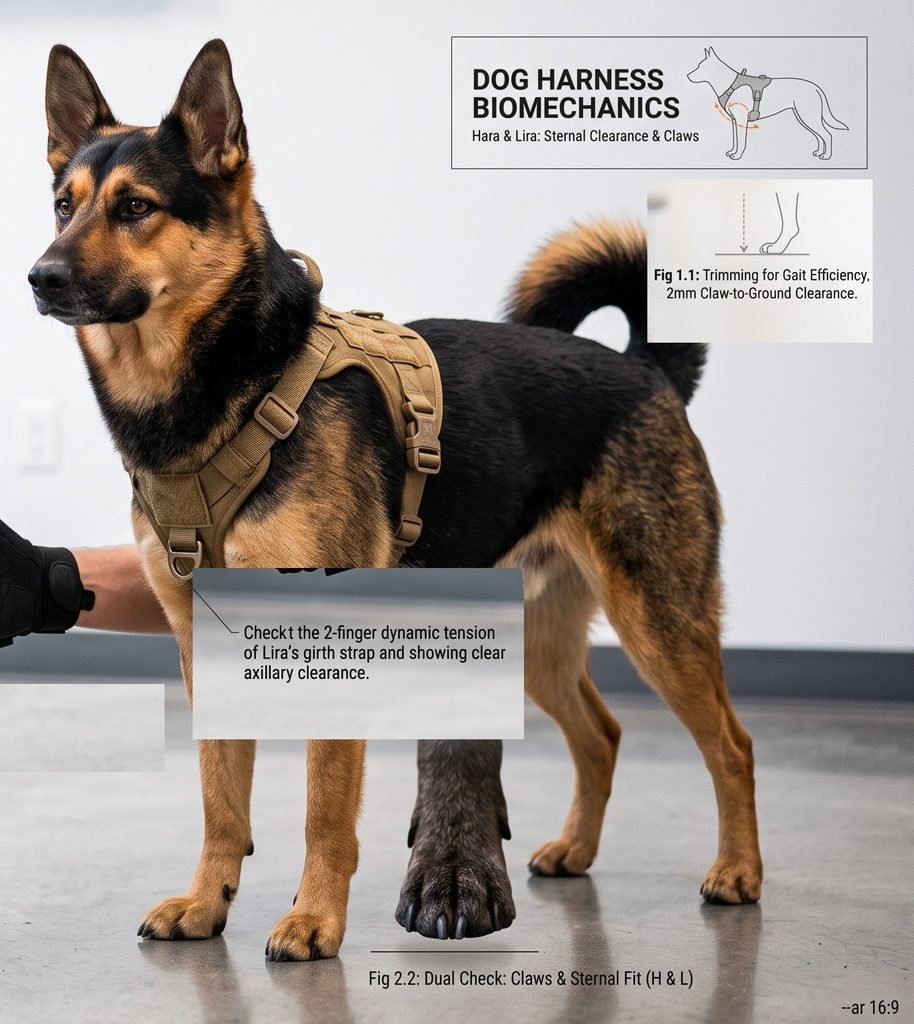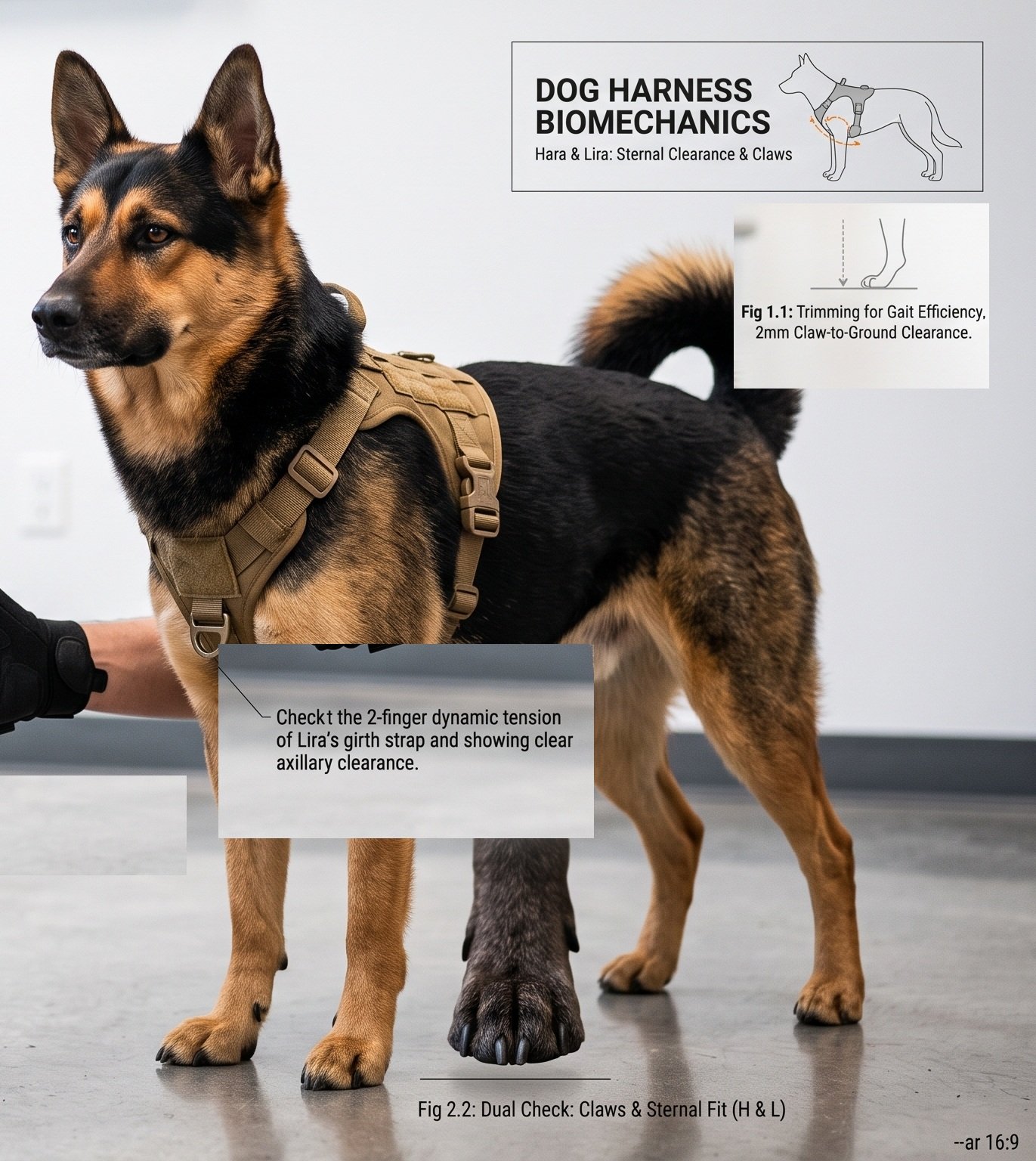
Understanding dog harness biomechanics is vital, as selecting walking gear based on handler convenience or physical restraint is an orthopedic error that invites chronic neurological trauma and cervical disc extrusion. When a dog lunges suddenly, kinetic energy multiplies by factors relative to body mass, focusing intensely on the structural contact zone. In high-drive crossbreeds combining the deep lever torque of German Shepherds with the explosive acceleration of Shiba Inus, small-surface collar forces induce acute tracheal collapse, ocular spike pressure, and subluxation across cervical vertebrae C4–C5. This protocol provides a biomechanical evaluation framework and a 3-step structural fitting formula to shield the axial skeleton.
1. Load Distribution Mechanics: Flat Collars vs. Ergonomic Harnesses
During sudden leash deceleration, external force ($F$) applied over an excessively narrow surface area ($A$) exponentially magnifies mechanical stress ($P = F/A$) across localized tissues.
The Pathological Triad of Cervical Constriction
- Intraocular Pressure (IOP) Spikes: Jugular vein compression restricts cranial venous drainage, instantly elevating IOP to over double its resting baseline—a proven catalyst for glaucoma and corneal edema.
- Tracheal Ring Deformity: Crushing forces against cartilaginous rings induce chronic laryngeal inflammation, rapidly deteriorating into permanent, irreversible tracheal collapse.
- Thyroid Parenchymal Trauma: Mechanical impacts delivered repeatedly across the ventral neck trigger trauma-induced autoimmune thyroiditis and endocrine dysfunction.
Comparative Biomechanical Performance Across Gear Configurations
| Gear Geometry | Impact Surface Area | Scapular Range of Motion (ROM) | Cervical & Ocular Risk | Target Activity Profile |
| Standard Flat Collar | Extremely Minimal (Ventral neck) | 100% Free | Critical | Static stationing, ID tags only |
| Y-Shaped Chest Harness | Broad (Sternum & rib cage) | 100% Unrestricted | Negligible (Optimal) | High-output running, trail hiking |
| Horizontal T-Bar (Norwegian) | Moderate (Transverse strap) | Impinges Scapular Glide | Moderate (Alters gait dynamics) | Discouraged (Restricted training only) |
| Front-Clip Sternal Harness | Moderate (Center mass vector) | Minor Restriction | Minimal | Anti-pull kinetic redirect training |
Biomechanical Warning: Horizontal chest straps (Norwegian/T-frame styles) physically blockade the forward swing of the humerus, forcing unnatural abduction, uneven paw placement, and early osteoarthritis across thoracic limbs.
2. The 3-Step Structural Alignment Protocol for Y-Harnesses
To preserve physiological joint kinematics, an ergonomic harness must center load-bearing points over the skeletal apex of the sternum via an unyielding mechanical Y-formation.
Anatomy-Driven 3-Step Fitting Directives
- Manubrium Sternal Registration: The central junction of the harness breastplate must rest directly over the manubrium (the prominent cranial bone of the breastplate), completely bypassing the soft cartilaginous trachea above it.
- Axillary Clearance Spacing: Maintain a clearance of at least 3 to 4 fingers (5–7 cm) between the front limb armpits and the main girth strap, eliminating friction sores and compensatory gait shifts.
- Dynamic Girth Tensioning (Two-Finger Rule): To accommodate respiratory expansion during strenuous sprints, adjust all straps until two flat fingers slide smoothly with light resistance beneath the webbing.
3. Kinetic Moment Control: Strategic Leash Vectoring
The physical attachment point (D-ring) dictates the vector trajectory through which braking forces interact with the canine spine.
Mechanics of Dorsal vs. Sternal Leash Placement
- Dorsal D-Ring (Back-Clip): Distributes linear tensile pull uniformly along the sagittal midline, making it the premier interface for steady-state jogging and loose-leash exploration.
- Sternal D-Ring (Front-Clip): When the dog surges forward, forward propulsion converts instantly into a rotational moment toward the handler, safely deflecting drive energy without impacting spinal alignment.
- Dual-Point Leash Control: Anchoring lines simultaneously to sternal and dorsal rings provides multi-axis stabilization, allowing balanced handling around reactive triggers without skeletal torque.
Frequently Asked Questions (FAQ)
Q1. Does switching to a harness encourage a dog to pull harder?
Pulling on a standard collar is frequently driven by the oppositional reflex—a natural attempt to relieve focal neck pain. A properly fitted Y-harness eliminates pain; pairing it with a front-attachment point and positive directional conditioning effectively curbs forward drive without mechanical injury.
Q2. Can active working dogs safely wear harnesses all day indoors?
Continuous indoor wear causes persistent coat friction, skin micro-abrasions, and poses critical strangulation hazards if webbing snags on domestic furniture. Reserve harness wear strictly for outdoor sessions and remove it indoors to facilitate lymphatic drainage.
Q3. Are wider webbing straps universally superior?
While broader webbing disperses mechanical pressure more efficiently, excessively wide straps impede scapular glide on medium-frame canines. High-density padded nylon webbing measuring 2.5 cm to 3.8 cm in width delivers the optimal compromise between impact attenuation and dynamic joint articulation.
Canine gear is not merely an external restraint; it is a critical safety system that absorbs violent deceleration forces. Securing that precise 1-centimeter alignment over the sternum ensures lifelong protection against debilitating cervical trauma and degenerative spinal disease.
Meta Description: Mechanical guide to canine walking gear: why collars compromise cervical and ocular health, and how to fit an ergonomic Y-harness to preserve joint mobility.