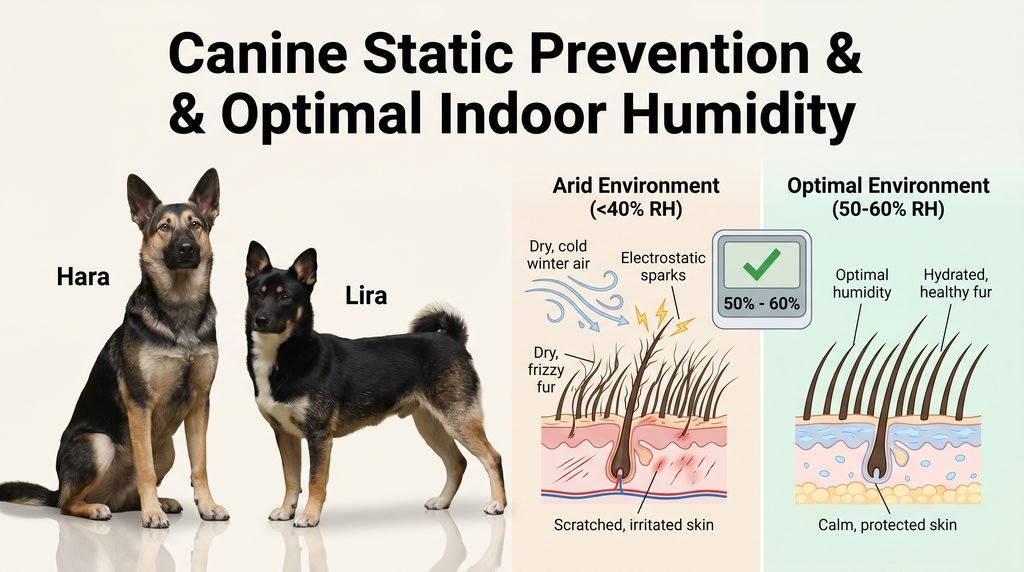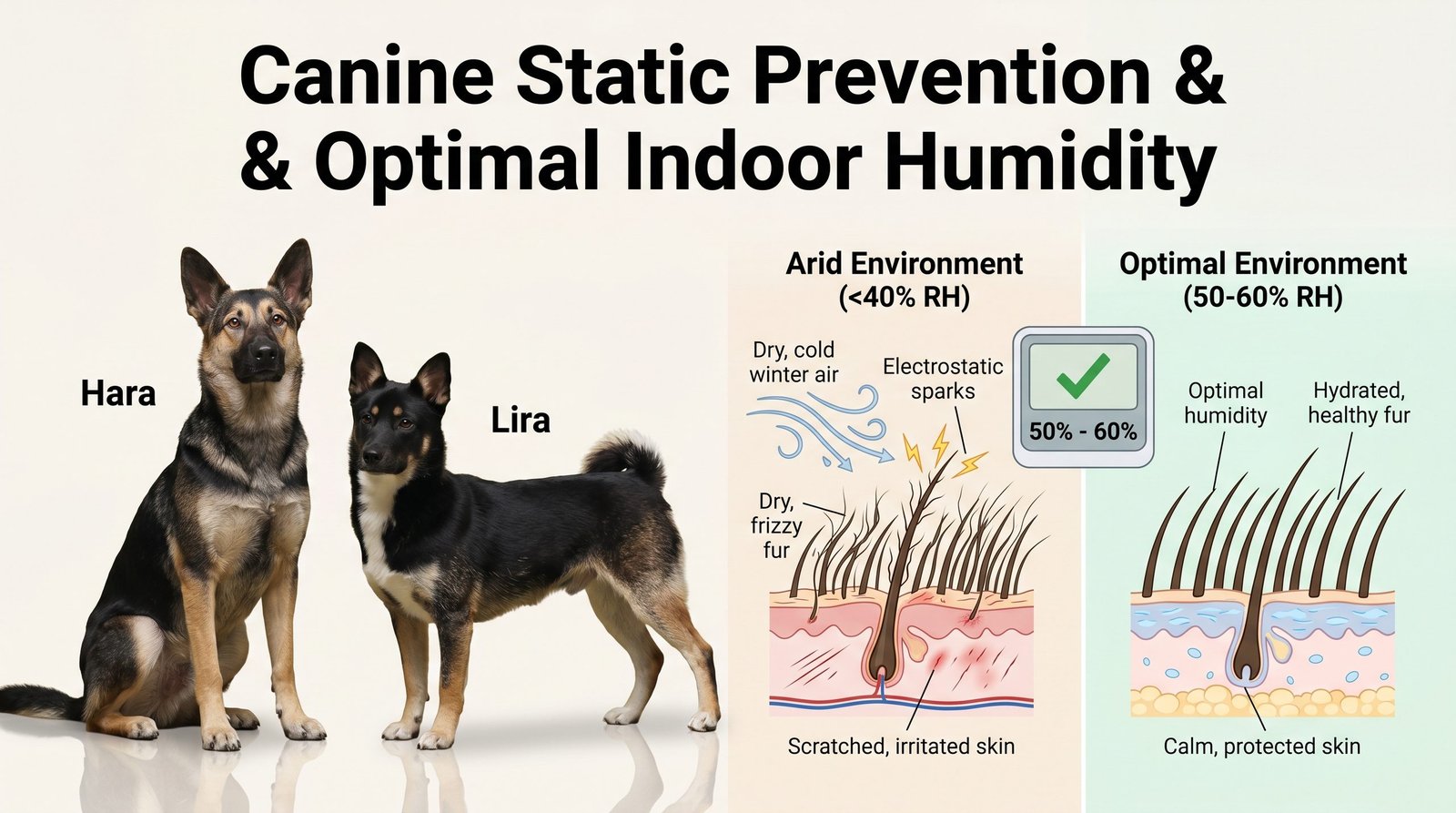
If you are struggling with dog static electricity during the dry winter months, your indoor heating and low humidity may be stripping your dog’s coat of moisture. The sharp crackle of static electricity when stroking a dog during winter is far more than a minor domestic nuisance; it is a clinical biomarker of epidermal barrier degradation and trans-epidermal water loss (TEWL). Dry indoor environments deplete cutaneous surface lipids and accelerate triboelectric charge accumulation, predisposing canines to pruritus, follicular micro-trauma, and chronic dermatological pathology.
Double-coated breeds—such as German Shepherd mixes like Hara or Jindo/Shiba mixes like Lira—possess dense configurations of undercoat and guard hairs that amplify contact friction. When indoor relative humidity drops, electrostatic adhesion exacerbates fur matting and skin inflammation. Establishing rigorous indoor environmental parameters is essential for structural coat vitality.
1. Physics of Triboelectric Charging and Canine Cutaneous Vulnerability
Comparative Epidermal Histology
The canine stratum corneum is remarkably delicate compared to that of humans. While human skin possesses 10 to 15 layers of nucleated corneocytes, canines possess merely 3 to 5 layers. Furthermore, canine skin exhibits a near-neutral to slightly alkaline surface pH (6.5 to 7.5), contrasting with acidic human skin (pH 5.5).
This distinct anatomy renders dogs susceptible to rapid transepidermal lipid evaporation. When relative humidity plummets, intercellular ceramides contract, leaving the keratinized hair shaft non-conductive. Friction from movement or touch induces rapid electron transfer, accumulating thousands of electrostatic volts that cannot dissipate into arid air.
[Arid Indoor Ambient Air (<40% RH)]
                 │
                 ▼
[Accelerated TEWL & Epidermal Lipid Depletion]
                 │
                 ▼
[Triboelectric Charge Accumulation on Guard Hairs]
                 │
                 ▼
[Static Discharge Shock → Neurological Guarding & Itching]
                 │
                 ▼
[Excoriation & Secondary Pyoderma Infiltration]
Double-Coat Triboelectric Amplification
Double coats feature coarse guard hairs shielding microscopic, crimped wool-like undercoats. In dry air, the surface area generated by tens of thousands of individual hair fibers multiplies friction exponentially compared to single-coated breeds.
Oppositely charged shafts repel adjacent fibers, creating coat splaying while electrostatically pulling ambient dander, dust, and allergens deep into the follicle base.
2. Evidence-Based Environmental Parameters for Musculoskeletal & Dermal Health
Indiscriminate humidification risks pulmonary irritation, mold growth, and dust mite proliferation. Conversely, unmanaged central heating severely desiccates dermal tissues. The validated optimal range balances skin hydration with respiratory safety.
| Environmental Metric | Target Range | Physiological Mechanism & Impact | Risk Thresholds |
| Relative Humidity (RH) | 50% to 60% | Dissipates triboelectric charge; preserves stratum corneum hydration >15% | <40% (Severe static), >65% (Dermatophyte proliferation) |
| Ambient Temperature | 18°C to 22°C (64°F to 72°F) | Preserves basal metabolic rate; inhibits panting-induced dehydration | >24°C (Accelerates respiratory water evaporation) |
| Airflow Velocity | ≤0.2 m/s | Eliminates forced convection desiccating surface coat lipids | Direct HVAC heating draft on bedding |
Biophysical Threshold: At 50% relative humidity, moisture molecules form a microscopic conductive layer on keratin fibers, allowing static charges to continuously bleed into the atmosphere before reaching human-perceptible discharge levels.
3. Four-Tier Clinical Protocol to Eliminate Static Shock
Step 1: Deploy Evaporative Humidification Over Ultrasonic Units
Ultrasonic humidifiers generate heavy water droplets that settle onto floors, causing local chilling and aerosolizing mineral dust. Cold-wick evaporative humidifiers introduce molecular vapor that diffuses homogeneously across living zones, sustaining 50–55% RH without moisture pooling.
Step 2: Reroute Thermal Convection Away from Canine Rest Areas
Forced-air furnace registers blowing dry air directly over dog beds accelerate cutaneous desiccation within minutes. Fit directional deflectors to vents, and place resting cushions over non-conductive, 100% natural cotton pads to neutralize floor-conduction friction.
Step 3: Implement Pre-Grooming Hydration Mists
Raking a metal slicker brush through a dry coat generates micro-electrical discharges that irritate nerve endings in hair follicles.
- Lightly mist coats with alcohol-free ceramide or colloidal oatmeal spray 60 seconds prior to brushing.
- Utilize antistatic wooden-pin brushes or pure boar bristles rather than plastic-handled tools.
Step 4: Lipid-Restorative Bathing Protocols
Avoid aggressive sulfate detergents that strip sebum. Utilize pH-balanced (6.5–7.0) restorative emollient shampoos followed by fatty-acid conditioners. A protective conditioning layer lubricates hair shafts, preventing frictional contact and static build-up.
4. Frequently Asked Questions (FAQ)
Q1. Why does my dog still experience static shocks despite the humidifier running?
Humidifiers often create localized moisture pockets near ceilings or adjacent walls. If your dog sleeps near a drafty floor or baseboard heater, their microclimate may still register below 35% RH. Position an accurate digital hygrometer directly at your dog’s bed height to verify actual floor-level metrics.
Q2. Does electrostatic shock cause measurable behavioral stress in dogs?
Yes. Unpredictable electrical discharges upon touching owners, blankets, or metal crates induce tactile aversion and anticipatory stress. Dogs frequently exhibit head-shying, flinching, reluctance to enter sleeping zones, or obsessive licking in response to persistent static discharge.
Q3. Can I apply diluted laundry fabric softener to control coat static?
Never. Fabric softeners contain quaternary ammonium compounds, phthalates, and synthetic fragrance matrices that cause contact dermatitis, epidermal ulceration, and systemic toxicity if ingested during grooming. Only use veterinarian-formulated leave-in conditioners.
Electrostatic discharge is not an inevitable winter reality; it is physical evidence of an impaired dermal environment. Calibrate your indoor humidity between 50% and 60% today to eliminate static pain and safeguard your dog’s coat integrity.
- Meta Description: Prevent canine static shock and coat damage. Discover the optimal indoor humidity range (50-60%) for double-coated breeds and scientific desiccation prevention tips.