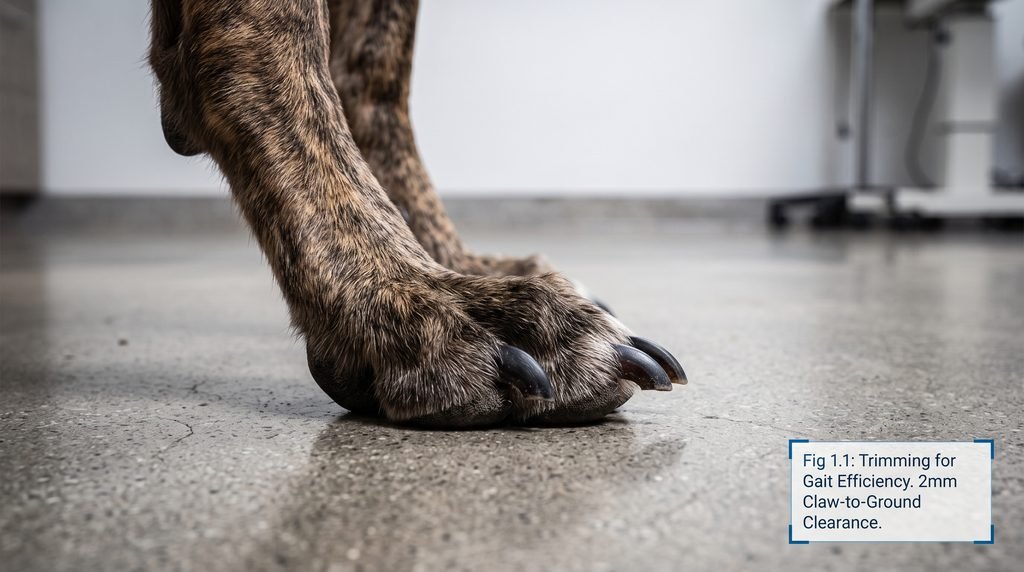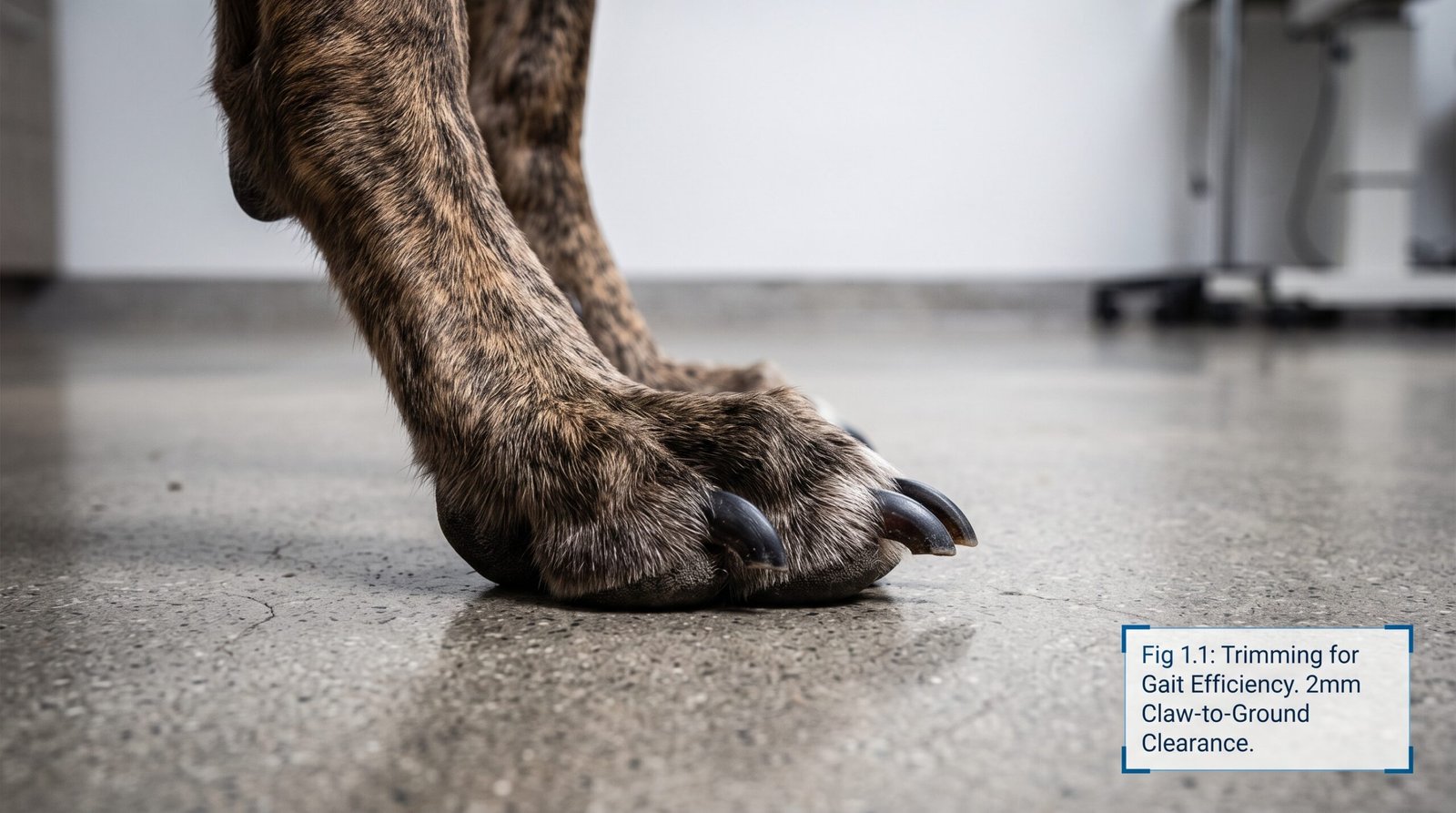
Understanding dog claw biomechanics is essential, as treating canine claw maintenance merely as an aesthetic or hygienic routine is a major orthopedic error. While claws provide critical mechanical traction and propulsion during locomotion, excessive length forces the distal phalanges into unnatural dorsiflexion upon ground impact. In high-drive crossbreeds combining the angular, heavy lever system of German Shepherds with the dense, spring-loaded agility of Shiba Inus, a mere millimeter of claw overgrowth initiates subluxation across digital joints and triggers destructive compensatory postural adaptations throughout the spinal column. This protocol outlines the kinetic hazards of overgrown claws and details a precision trimming procedure to induce safe vascular (quick) recession.
1. Kinematic Cascade of Claw-Ground Collision
Under optimal anatomical alignment, a standing dog’s claws must hover 2 to 3 millimeters above flat terrain, producing zero audible clicking during level walking. The instant a claw bears continuous ground contact, the global kinetic chain destabilizes.
Digital Deformity and Propulsion Deficits
- Hyperextension of Interphalangeal Joints: Continuous upward floor forces lever the distal phalanx (P3) backward, placing chronic eccentric strain on the deep digital flexor tendon.
- Compensatory Caudal Weight Shift: To evade focal digital discomfort, the dog shifts its center of mass caudally onto the metacarpal and metatarsal pads, creating abnormal hyperextension of the hocks and internal rotation of the carpus.
- Axial Skeleton Strain and Compensatory Lameness: Loss of clean sagittal break-over forces compensatory outward leg swings (circumduction), accelerating sacroiliac instability and lumbar intervertebral disc disease (IVDD).
Biomechanical Hazard Index by Claw Length
| Claw Extension State | Ground Contact Status | Tendon Tensile Strain | Postural Compensation Risk | Action Protocol Frequency |
|---|---|---|---|---|
| Optimal Alignment | 2–3mm Ground Clearance | Baseline Normal | Negligible | Bi-weekly micro-grinding |
| Mild Elongation | Touches when standing | Early Micro-Tension | Low (Focal joint fatigue) | Weekly clipping & contouring |
| Severe Overgrowth | Lifts digital pads off floor | Chronic High Strain | Critical (Phalangeal subluxation) | Twice-weekly quick recession |
| Ingrown / Lateral Curl | Pierces pad / Torsion | Extreme Shear Force | Emergency (Irreversible lameness) | Surgical clipping & cautery |
Biomechanical Evaluation Rule: When your dog stands squared on a hard, level floor, a standard sheet of paper must slide freely beneath every claw without frictional resistance.
2. The 4-Step Beveling Protocol for Quick Recession
Darkly pigmented claws conceal the internal neurovascular core (the quick), frequently causing owner hesitation and prolonged neglect. Abandon single-crush cross-sectional cuts in favor of a 45-degree multi-plane beveling protocol.
Gradual Quick Recession Protocol
- Digital Isolation and Stabilization: Disinfect the cutter; apply light dorsal-palmar pressure directly on the digital pad to firmly lock the flexor tendon and expose the nail hook.
- 45-Degree Strategic Bevel Cut: Do not truncate the claw perpendicular to its growth axis. Shave micro-slices (1–2mm) at a downward 45-degree angle matching the natural taper of the dorsal nail wall.
- Core Morphology Identification: Inspect the cut surface after each pass. When the chalky white keratin transitions into a moist, oval gray-black focal point (the living quick capsule), cease bladed cutting immediately.
- Circumferential Rotary Contouring: Utilize a high-torque, low-vibration rotary tool (Dremel) to bevel the lateral and dorsal edges smooth, stripping external structural support from the quick to stimulate physiological vascular regression.
3. Emergency Hemostasis and Instrument Mechanics
Panicked reactions following accidental vascular transection instill severe veterinary phobia and trim-aversion in athletic canines.
Chemical Compression Protocol for Hemorrhage
- Direct Styptic Application: Never wipe a bleeding claw with gauze, as this dislodges forming fibrin nets. Pack a ferric-subsulfate styptic powder directly onto the apex using a cotton applicator, maintaining firm perpendicular compression for 30 uninterrupted seconds.
- Emergency Household Substitutes: In the absence of medical styptic compounds, compress dry cornstarch or baking powder onto the bleeding tip to establish an immediate mechanical plug.
- Blade Edge Integrity: Dull shears crush and splinter the horn sheath rather than severing it, transmitting acute mechanical shock into the periosteum. Replace clipper blades every 6 to 8 months depending on operational volume.
Frequently Asked Questions (FAQ)
Q1. Does daily road walking eliminate the need for manual claw trimming? Pavement abrasions grind down central claws, but dewclaws (first digits) experience zero substrate contact and can grow into painful spirals that tear into the leg fascia. Furthermore, uneven gait mechanics wear claws asymmetrically, necessitating regular corrective contouring.
Q2. How can I safely shorten claws when the quicks have grown excessively long? Do not attempt rapid correction. Shave the hard keratin tip 1 millimeter in front of the live quick every 3 to 4 days. As outer mechanical housing erodes, the inner vascular bed naturally recedes through lack of structural support.
Q3. How can I reduce stress if my dog fears rotary grinder vibrations? Implement a 3-day desensitization routine pairing the distant humming sound of the motor with high-value treats before physical contact. During grinding, limit friction to 3-second intervals per nail to avoid thermal heat transfer through the claw horn.
Maintaining proper dog claw biomechanics is not merely cosmetic; it is the fundamental ground-interface anchor of your dog’s musculoskeletal longevity. Disciplined maintenance safeguards joints and prevents chronic degenerative lameness across high-energy working breeds.
Meta Description: Biomechanical guide to canine claw health: how overgrown nails distort posture, step-by-step black claw trimming, and quick recession protocols.