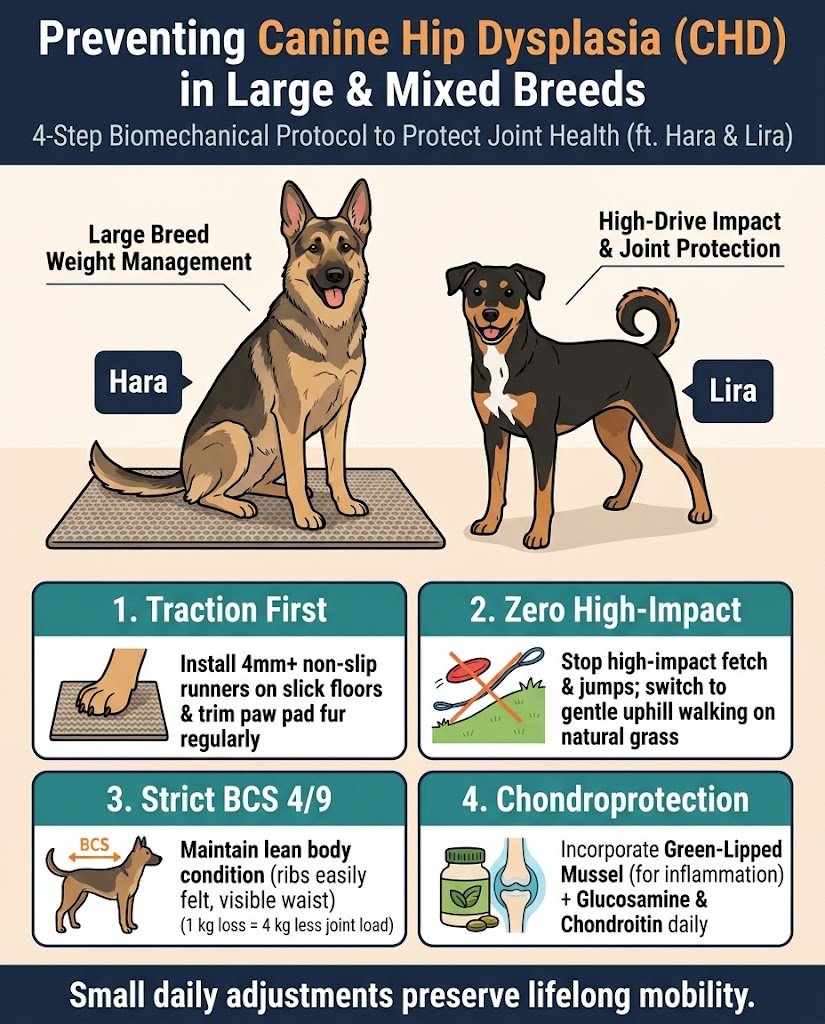
Effective canine hip dysplasia prevention is critical for medium-to-large breeds undergoing intense skeletal growth and energetic mixed breeds. Canine Hip Dysplasia (CHD) is far more than a simple genetic defect. Subtle laxity within the coxofemoral joint—where the pelvic acetabulum cups the femoral head—rapidly progresses into irreversible Degenerative Joint Disease (DJD) when aggravated by slick interior flooring, excess body weight, and repetitive high-impact vertical landings.
Synthesizing clinical biomechanics with empirical management protocols established for Hara (a robust German Shepherd mix bearing substantial downward load) and Lira (an agile, high-torque mixed breed with dense hindquarter musculature), this guide details a comprehensive four-step non-surgical protocol to preserve joint congruency long before surgical intervention becomes necessary.
Pathophysiology of CHD and Early Diagnostic Signs of Joint Laxity
The canine hip functions as an organic ball-and-socket mechanism. In an anatomically sound joint, the acetabular rim encapsulates the femoral head securely, evenly dispersing kinetic forces across resilient articular cartilage. When connective ligaments slacken, micro-subluxation begins abrading the chondral surfaces.
Subtle Gait Anomalies Preceding Overt Lameness
Pet parents typically seek veterinary intervention only when an animal shows overt limping; however, structural degradation begins months prior.
- Bunny Hopping: Driving both hind legs forward simultaneously during sprints rather than executing an alternating, fluid stride.
- Pelvic Swaying: An exaggerated lateral rocking of the pelvis during standard walking, signaling compensatory muscular recruitment.
- Difficulty Rising: Reluctance to drive upwards from a recumbent posture using the hind limbs, transferring the majority of lifting force onto the forequarters.
Phenotypic Risk Factors: Large vs. High-Drive Mixed Breeds
Broad-chested, heavy-boned dogs (represented by Hara’s structural profile) exert continuous compressive force downward onto the acetabular cup. Conversely, muscular, athletic builds prone to explosive sprinting (represented by Lira) transfer severe shear stress onto the joint capsule during sudden stops and angular turns.
Four-Step Environmental and Biomechanical Joint Defense Protocol
Mitigating micro-trauma requires an integrated approach that fortifies surrounding stabilizing soft tissues (quadriceps, gluteals, and biceps femoris) while systematically eliminating environmental traction failure.
Step 1: Optimizing Floor Traction Coefficients
Polished hardwood, laminate, and glazed ceramic tiles exhibit an exceptionally low friction coefficient. Each micro-slip drives the femoral head outward against the acetabular rim, causing micro-tears in the joint capsule.
- Install heavy-duty non-slip interlocking EVA or textured TPU runners (minimum 4mm thickness) across primary indoor thoroughfares, room transitions, and furniture landing zones.
- Routinely trim interdigital fur level with the paw pads to ensure natural paw friction remains uncompromised.
Step 2: Eliminating Vertical Impact and Structuring Low-Impact Resistance
“When designing a routine for canine hip dysplasia prevention, high-speed frisbee launches and jumps exceeding 1 meter must be eliminated immediately.” High-speed frisbee launches and jumps exceeding 1 meter exert peak concussive forces up to 400–500% of the animal’s total body weight directly onto the coxofemoral cartilage.
- Cease high-impact ball chasing immediately. Substitute with controlled, slow hill-walking on a 5–8 degree natural grass incline to isolate and fortify the biceps femoris.
- Incorporate isometric core conditioning via low-profile balance discs or inflatable platforms for 5 minutes daily to sharpen proprioceptive joint stabilization.
Step 3: Enforcing a Strict Body Condition Score (BCS 4/9)
Every 1 kg of excess visceral weight multiplies the load on the hip joint by roughly four times during locomotion. Maintain a Body Condition Score of 4/9 (lean profile: ribs easily palpable under minimal adipose tissue, distinct waistline visible from dorsal perspective).
Step 4: Targeted Cartilage Chondroprotection and Anti-Inflammatory Stacking
- Glucosamine HCl & Low Molecular Chondroitin Sulfate: Provides foundational glycosaminoglycan precursors to preserve synovial fluid viscosity.
- Lipid-Dense Green-Lipped Mussel Extract & Omega-3 (EPA/DHA): Downregulates pro-inflammatory eicosanoids and suppresses matrix metalloproteinases (MMPs) that actively degrade cartilage.
Essential Hip Health Protocol vs. High-Risk Behaviors
| Management Category | Recommended Protocol | High-Risk Danger |
| Indoor Traction | Full-coverage non-slip runners & trimmed pads | Unprotected slick hardwood floors & tile |
| Exercise Dynamic | Controlled leash walking, steady natural inclines | Ball chasing, repetitive jumps, jumping from SUVs |
| Weight Target | Strict BCS 4/9 (visibly defined waistline) | Overfeeding, surplus weight (BCS 6+), heavy treats |
| Mobility Aids | Support harness for stairs, car ramps | Unassisted drops onto hard concrete surfaces |
Warning: Pediatric Neutering and Growth Plate Integrity
In large breeds, distal femoral and tibial growth plates do not reach complete ossification until 12 to 18 months of age. Performing gonadectomy prior to hormonal maturity delays growth plate closure, causing abnormal leg elongation that destabilizes hip angles. Confirm plate closure via radiographic imaging before scheduling neutering.
Frequently Asked Questions (FAQ)
Q1. My dog’s X-rays reveal moderate dysplasia, but they display no overt signs of pain. Do I still need to intervene?
A. Yes. Canine evolutionary biology dictates masking chronic physical discomfort to avoid vulnerability. Microscopic osteophyte formation (bone spurs) and synovitis progress steadily even in stoic dogs. Implementing non-slip flooring and weight optimization immediately halts subclinical joint deterioration.
Q2. Is swimming universally safe for dogs showing early signs of hip weakness?
A. Swimming offers superb non-weight-bearing cardiovascular and muscular conditioning, but panicky flailing or aggressive hyperextension when entering or exiting water can strain the joint capsule. Always equip your dog with a supportive life vest and ensure entry occurs via a gradual, shallow ramp.
Conclusion: Daily Consistency Dictates Long-Term Mobility
“Long-term canine hip dysplasia prevention rarely happens overnight, nor can it be achieved by a single miracle supplement.” Canine Hip Dysplasia rarely manifests overnight, nor can it be erased by a single miracle supplement. Eliminating slick floor friction, shaving off a single pound of excess fat, and curbing destructive vertical leaps preserves the integrity of the femoral head day by day. By implementing these measures now, dynamic companions like Hara and Lira can continue bounding freely across open fields with comfort, structural strength, and enduring vigor well into their senior years.