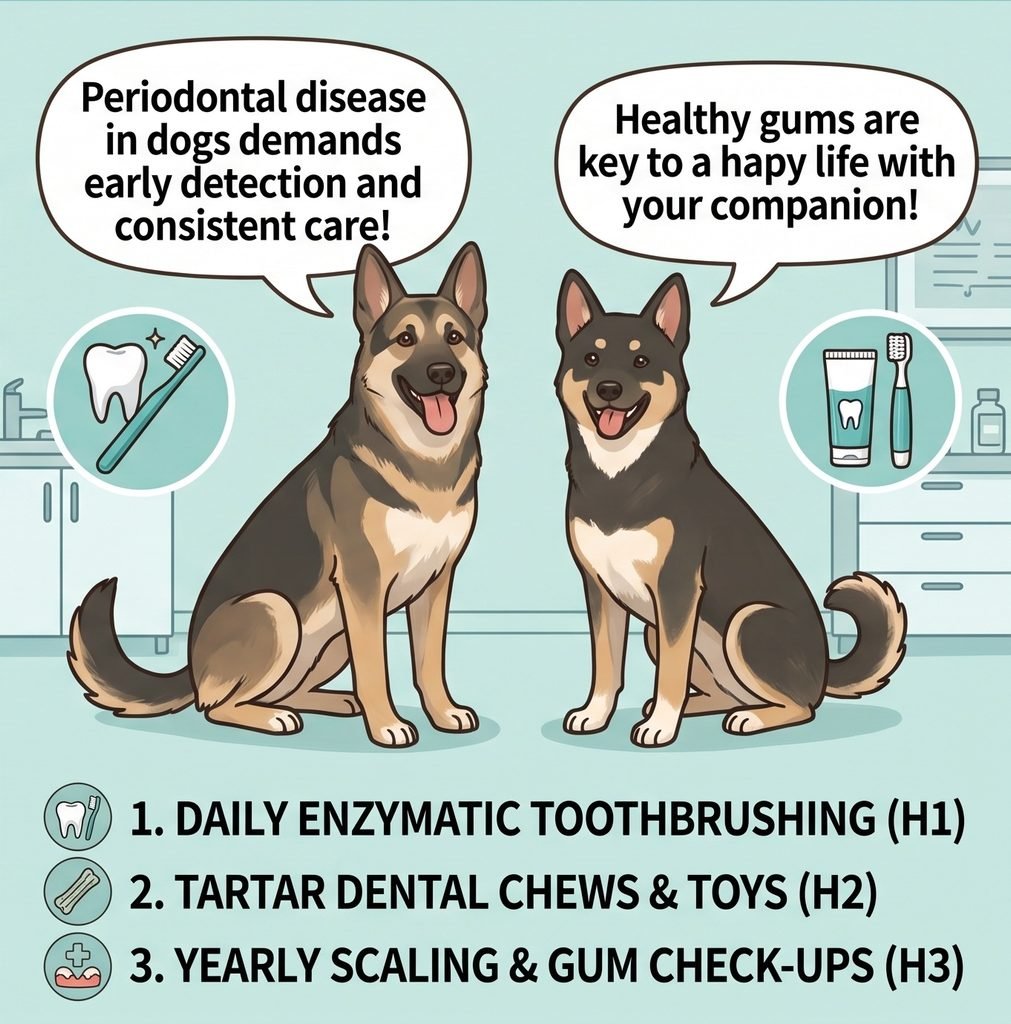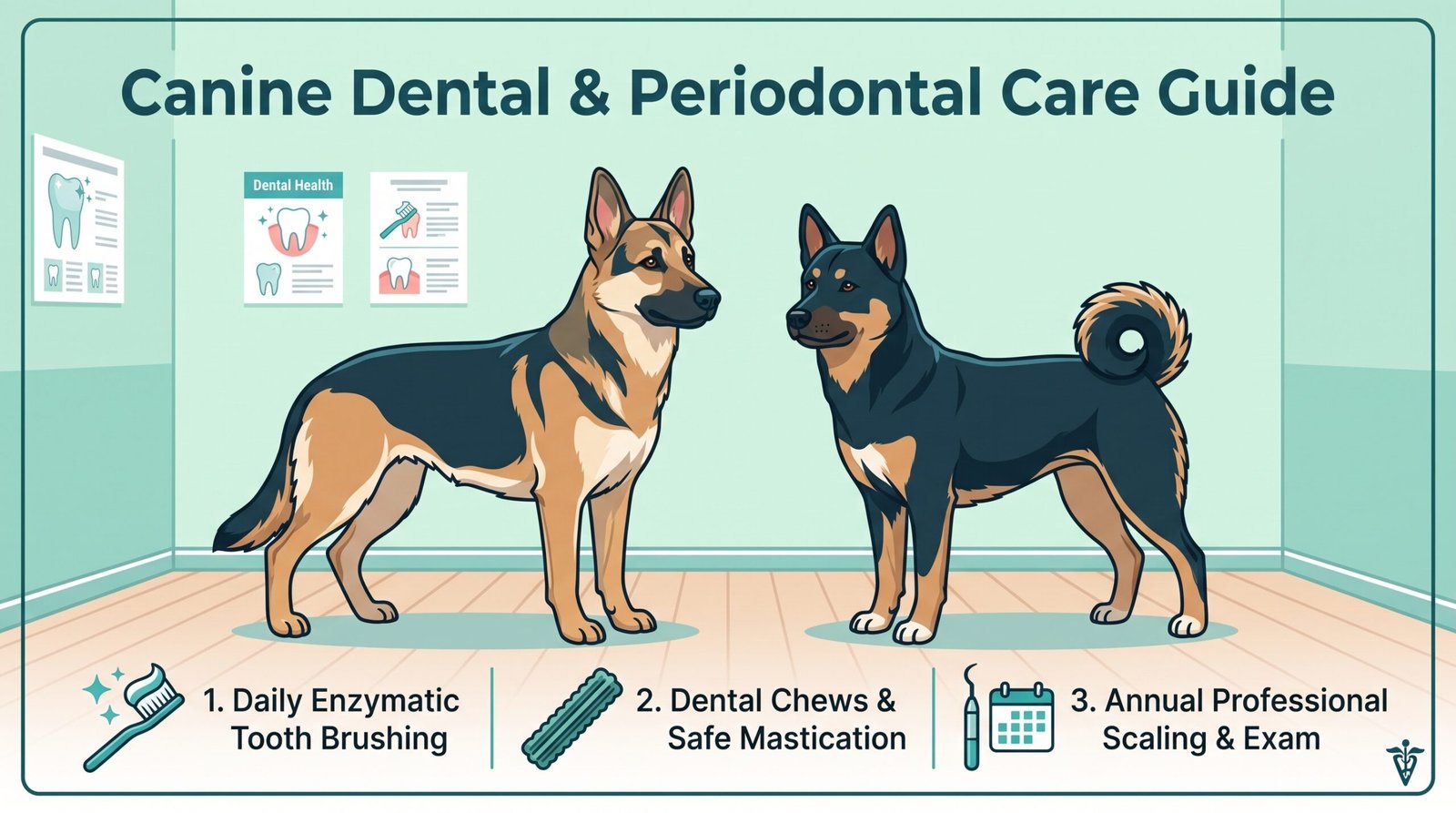
Effective canine periodontal disease prevention directly governs systemic longevity far beyond cosmetic breath control. Periodontal pathogens entering through inflamed gingival micro-fissures represent a primary vector for bacteremia, contributing to bacterial endocarditis, chronic renal glomerulonephritis, and hepatic micro-abscesses. According to the American Veterinary Dental College (AVDC), over 80% of canines exhibit active stages of periodontal pathology by age three. Athletic canines—such as Hara (a large German Shepherd cross with deep facial folds) and Lira (an alert Black-and-Tan Jindo mix prone to handling sensitivities)—require tailored behavioral protocols and biomechanical understanding of masticatory loads. This guide delineates plaque calcification dynamics, a four-step desensitization blueprint, chew toy safety standards, and veterinary hygiene criteria.
1. Biofilm Pathophysiology: From Salivary Pellicle to Calculus
Canine saliva maintains an alkaline environment (pH 7.5 to 8.5). While this high alkalinity naturally deters cariogenic demineralization (human-style cavities), it expedites mineral precipitation, transforming soft plaque into concrete calculus roughly five times faster than in humans.
1-1. The 48-Hour Calcification Window
- Stage 1 (Gingivitis): Within 24 hours of feeding, salivary glycoproteins aggregate with aerobic cocci on the enamel surface. Gingival margins present hyperemia and edema. At this stage, tissue disruption is completely reversible through daily mechanical plaque abrasion.
- Stages 2 to 4 (Periodontitis): Without intervention, unmineralized biofilm incorporates calcium carbonate and phosphate ions from salivary secretions, hardening into tenacious subgingival calculus within 48 to 72 hours. An anaerobic shift (notably Porphyromonas gulae and Treponema denticola) releases collagenases that destroy the periodontal ligament and alveolar bone, mandating irreversible surgical extractions.
1-2. Hematogenous Dissemination and Organ Damage
- Cardiovascular Axis: Sustained bacteremia compromises mitral and tricuspid valve margins, leading to endocardial vegetative lesions and secondary congestive heart failure.
- Renal Axis: Circulating antigen-antibody complexes become trapped in glomerular capillaries, precipitating progressive interstitial nephritis.
2. A 4-Step Behavioral Desensitization Protocol
Forcing a rigid toothbrush into an untrained dog’s mouth creates conditioned defensive aggression or oral tactile aversion. A systematic counter-conditioning protocol ensures compliance without restraint distress.
[Phase 1] Lip Tactile & Paste Licking ➜ [Phase 2] Gauze Friction Exposure ➜ [Phase 3] 45-Degree Molar Brushing ➜ [Phase 4] 60-Second Buccal Routine
2-1. Daily Desensitization Execution Steps
- Phase 1: Labial Manipulation & Enzymatic Scent Pairing (Days 1–4)Keep brushes hidden. Dispense a pea-sized amount of enzymatic malt- or poultry-flavored pet toothpaste onto your index finger. Allow voluntary licking while gently elevating the lateral flews for three seconds, followed immediately by high-value verbal and sensory reward.
- Phase 2: Gauze Wipe Conditioning (Days 5–9)Wrap sterile cotton gauze around your index finger, apply enzymatic paste, and sweep across the labial aspects of the canine teeth and incisors for five seconds. Do not pry the mouth open.
- Phase 3: Introducing the 45-Degree Bristle Vector (Days 10–14)Transition to an ultra-soft angled canine toothbrush. Direct bristles at a 45-degree angle toward the gingival sulcus. Focus predominantly on the maxillary fourth premolar (the large upper shearing carnassial), which aligns directly below the parotid salivary duct where calculus deposits most rapidly.
- Phase 4: Establishing the 60-Second Full Arch RoutineCanine tongue movement continuously cleans the lingual (internal) surfaces of the teeth. Consequently, over 90% of calculus accumulates on the buccal (cheek-facing) surfaces. Confine the session to the exterior surfaces, completing both upper and lower quadrants within 60 seconds to prevent cognitive burnout.
3. Masticatory Chews and Dental Toy Structural Safety
While chewing provides secondary mechanical plaque scraping, improper material density causes severe traumatic dental fractures.
3-1. The Fingernail Impression Rule
- The Thumbnail Test: If an object cannot be indented slightly with your thumbnail, it is excessively rigid for canine enamel.
- Contraindicated Materials: Raw marrow bones, boiled beef knuckles, antlers, hooves, and dense nylon bones are the leading clinical cause of upper fourth premolar “slab fractures.”
- Recommended Substrates: Utilize products stamped with the Veterinary Oral Health Council (VOHC) seal of acceptance or flexible natural rubber treat-dispensers coated internally with enzymatic dentifrice.
3-2. Oral Hygiene Interventions Comparison Matrix
| Modality | Daily Enzymatic Brushing | VOHC-Approved Dental Chews | Water Additives | Veterinary Anesthetized Scaling |
| Mechanical Biofilm Clearance | Maximum (Direct scraping) | Moderate (Coronal contact) | None (Chemical action only) | Complete (Subgingival curettage) |
| Prescribed Frequency | 1–2 times daily | 3–4 times weekly | Daily drinking water dilution | Annually |
| Primary Clinical Benefit | Eliminates soft bacterial film | Salivary stimulation & wear | Reduces volatile sulfur odors | Eradicates deep pocket calculus |
| Critical Precautions | Use fluoride-free pet paste | Monitor caloric contribution | Screen for digestive sensitivity | Mandatory pre-anesthetic lab work |
4. The Perils of Non-Anesthetic Dental Scaling (NADS)
Offering cosmetic “anesthesia-free” teeth cleaning at grooming salons or non-clinical facilities poses grave health risks:
- Enamel Micro-Grooving: Hand scalers scratch enamel surfaces without immediate motorized polish, creating microscopic valleys where new bacteria bind exponentially faster.
- Subgingival Neglect: True periodontal pathology lives within the subgingival pocket beneath the gumline. Scraping visible calculus above the gumline produces a false sense of hygiene while destructive alveolar bone lysis continues silently underneath.
- Physical Trauma: Conscious restraint during sharp instrumentation frequently leads to tongue lacerations and fractured jaw roots. Comprehensive cleaning requires intubated airway protection, full-mouth intraoral radiography, ultrasonic scaling, and subgingival polishing.
Frequently Asked Questions (FAQ)
Q1. Can human toothpaste be substituted if formulated for children?
No. Human dental products contain xylitol (a potent sweetener causing catastrophic hepatic necrosis and acute hypoglycemia in dogs) and foaming surfactants like sodium lauryl sulfate, which induce severe gastric distress when swallowed. Always utilize non-foaming enzymatic formulations designed specifically for domestic canines.
Q2. My dogs Hara and Lira chew vigorously on synthetic toys; does this eliminate the need for brushing?
No. Chewing acts merely as supplementary coronal friction. It fails to penetrate the critical subgingival sulcus where pathogenic anaerobes establish colonies. Daily bristle contact remains the irreplaceable clinical standard for periodontitis prevention.
Q3. How can I differentiate between harmless food stains and genuine subgingival calculus?
Superficial dietary pigments wash away or remain flat on the smooth enamel surface. In contrast, calculus presents as a raised, rough, yellowish-brown crust clustered along the cervical margin adjacent to the pink gingival tissue, frequently accompanied by localized marginal erythema and halitosis.
Conclusion and Implementation Blueprint
Preserving oral integrity through structured canine periodontal disease prevention is fundamentally an exercise in bacterial threshold control rather than cosmetic whitening. Do not attempt a full-mouth scrubbing on day one. Tonight, simply apply a small ribbon of enzymatic paste to your fingertip and spend 60 seconds desensitizing your dog to gentle gumline touch. That brief, low-stress interaction establishes the behavioral foundation that protects companions like Hara and Lira from silent organ strain and keeps them chewing happily well into their golden years.
- Meta Description: Discover the veterinary-backed canine periodontal care guide, featuring a 4-step brushing desensitization plan, chew toy safety standards, and scaling protocols.