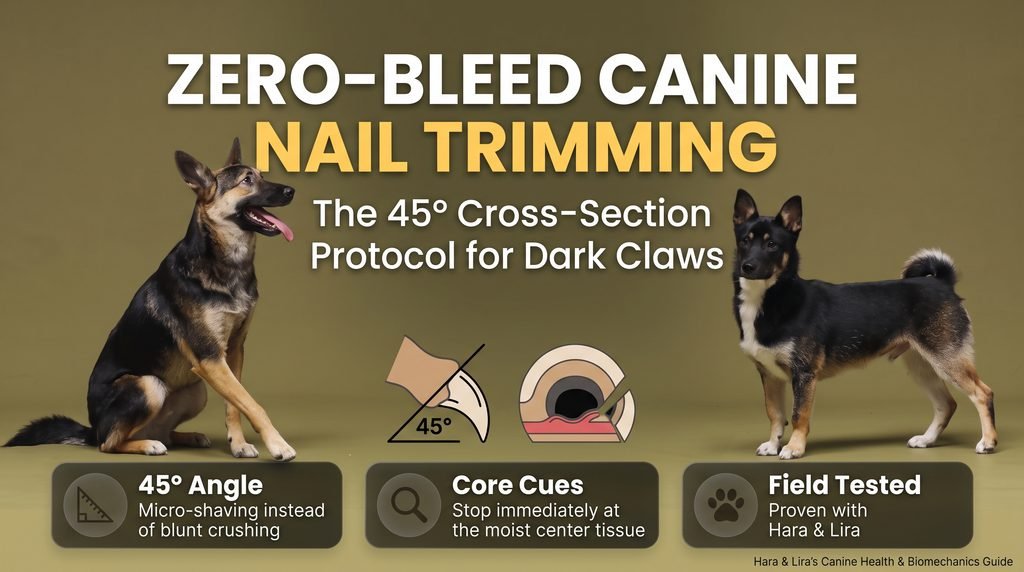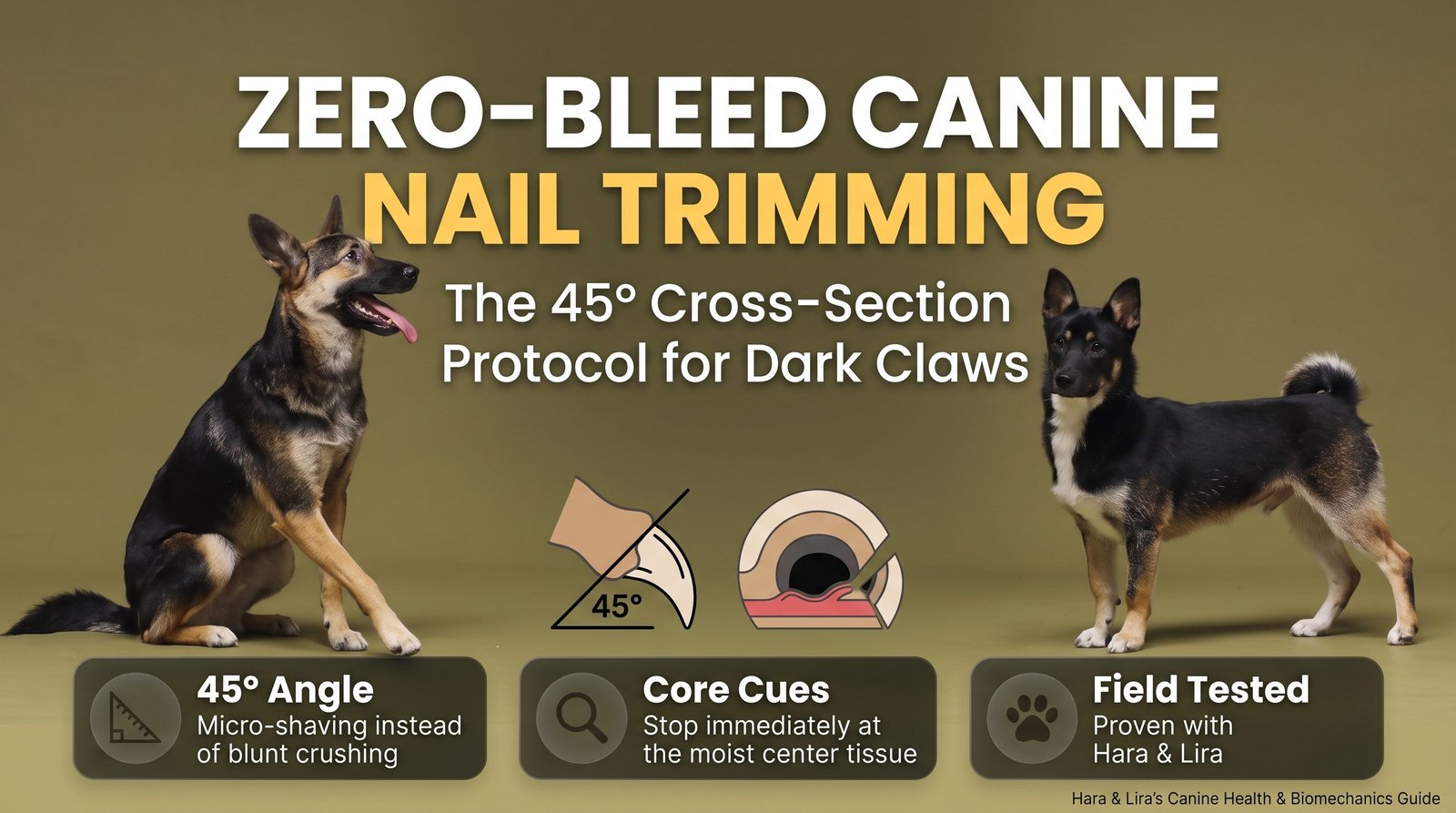
Learning how to trim black dog nails without causing pain or bleeding is one of the most challenging grooming tasks for pet owners. Accidental quick strikes during canine nail trimming are rarely caused by poor handling alone; rather, they stem from cutting across non-transparent keratin at indiscriminate angles without reading internal structural transitions. For athletic mixed breeds bearing thick, black nails where the blood vessel (Quick) cannot be identified under backlighting, a single painful bleeding episode can permanently solidify defensive foot sensitivity.
When mastering how to trim black dog nails, traditional blunt clipping must be replaced by a systematic, anatomy-first method. This clinical guide deconstructs the zero-bleed “Micro-Shaving Cross-Section Technique” and outlines an evidence-based maintenance protocol to safely stimulate biological quick regression.
1. Functional Claw Anatomy & Mechanical Leverage
A canine claw comprises a dense outer keratin sheath encasing the “Quick”—a highly sensitive vascular core containing nerves and capillary beds connected to the distal phalanx.
Quick Elongation and Kinetic Chain Misalignment
When claws remain unclipped, the vascular core migrates outward along the expanding keratin shell. Excessively long nails alter normal paw strike mechanics on hard substrates, shifting weight backward onto the metacarpal and metatarsal pads. This abnormal lever arm forces compensatory postural shifts through the hocks, stifles, and lumbar spine, serving as an overlooked contributor to secondary degenerative joint disease.
Mechanical Mechanics: Scissor-Style vs. Guillotine Trimmers
The structural force delivered to the claw matrix differs drastically by tool engineering:
- Guillotine Clippers: A single blade retracts through a fixed ring. As blades dull, they exert lateral crushing pressure before shearing, transmitting mechanical shock directly to nerve fibers. They should be strictly avoided on medium-to-large breeds.
- Heavy-Duty Scissor/Plier Clippers: Dual curved blades converge simultaneously, delivering a clean shear cut that minimizes crushing and prevents longitudinal split fractures across thick, dense claws.
2. The 3-Stage Cross-Section Trimming Protocol
Trimming dark nails requires abandoning the concept of a single terminal cut. Instead, shave micro-layers (1mm increments) from the claw tip while inspecting the center of the cross-section.
Step 1. Aligning the 45-Degree Relief Plane
Never cut perpendicular to the claw. Align the blades beneath the nail at a 45-degree angle, parallel to the natural wear plane of the paw pad. Dewclaws, which experience zero ground attrition, must be addressed first as their circular growth path directly threatens the skin envelope.
Step 2. Decoding Cross-Sectional Morphologies
Inspect the newly exposed cut surface under bright, direct light after each stroke:
- Dry Chalky White/Grey Core: Pure structural keratin. It is safe to take another thin pass.
- Homogeneous Dark Opaque Oval: Proximity to the outer protective pulp of the vascular bed. Cease heavy clipping and switch immediately to an abrasive file.
- Moist, Soft Center Point: The active quick tissue boundary. Stop immediately. Advancing even 0.5mm past this threshold will sever capillaries.
[Cross-Section Morphology Guide]
[Stage 1: Chalky White] ──(1mm Slice)──> [Stage 2: Homogeneous Oval] ──(Rotary File)──> [Stage 3: Moist Core Point] (STOP!)
Step 3. Thermal-Controlled Rotary Grinding
Smooth jagged perimeter edges with a rotary sanding drum. Restrict tool engagement to 2 to 3 seconds per nail to avoid thermal nerve irritation caused by continuous friction.
3. Maintenance Matrix by Phenotype & Pigmentation
| Phenotype | Biological Characteristics | Preferred Tool Protocol | Critical Safety Factor |
| Clear/Translucent Claws | Quick visible as an internal pink cone | Standard scissor trimmer + manual buffer | Leave a 2mm safety margin ahead of the visible pink boundary. |
| Fully Pigmented/Black Claws | Melanin blocks external visual assessment | Heavy-duty plier-type + low-vibration rotary file | Rely strictly on cross-section moisture cues; advance in 1mm increments. |
| Neglected/Elongated Claws | Quick has advanced near the tip of the claw | Fine-grit rotary grinder (bi-weekly sessions) | Do not attempt full length reduction in one session; stimulate natural recession. |
4. Hemostatic Emergency & Trauma Mitigation Rules
If a capillary is accidentally breached, emotional composure prevents the canine from internalizing a fear association.
Absolute Rule on Hemostasis: Never wipe away flowing blood with dry gauze; wiping disrupts early platelet aggregation. Apply localized mechanical pressure directly using a coagulant agent.
- Direct Application of Styptic Agent: Press a liberal amount of styptic powder (ferric subsulfate) directly against the bleeding apex using firm, stationary pressure for 30 to 60 seconds without wiping.
- Household Alternatives: In an emergency, cornstarch or baking flour packed firmly into the claw tip provides a temporary physical plug.
- High-Value Counter-Conditioning: Immediately dispense an ultra-high-value reward to mitigate stress and recondition the emotional response to handling.
Frequently Asked Questions (FAQ)
Q1. My dog’s nails click loudly on hard floors, but the quicks are too long to cut back. How can I shorten them?
An elongated quick cannot be forced backward in a single session. Trim or grind the keratin right up to the boundary of the quick once every 5 to 7 days. As the outer structural support is progressively removed, the internal tissue experiences increased atmospheric exposure and micro-pressure, naturally receding backward by 1 to 2mm over consecutive weeks.
Q2. My dog growls as soon as the clippers are visible. How do I proceed?
Break the conditioned fear response via low-threshold counter-conditioning. Pair the mere sight of the clippers with a premium food reward on Day 1. Transition to touching the paws with the handle on Day 2, and tapping the claw without cutting on Day 3. Only trim a single nail per day once the dog remains fully calm throughout handling.
Flawless claw maintenance is not defined by aggressive length reduction, but by consistent, trauma-free sessions that protect anatomical alignment. Target just one claw today, apply the 45-degree angle, and build long-term trust one millimeter at a time.
- Meta Description: Master safe black dog nail clipping with the 45-degree micro-shaving method, cross-section identification cues, quick regression timelines, and emergency hemostasis protocols.