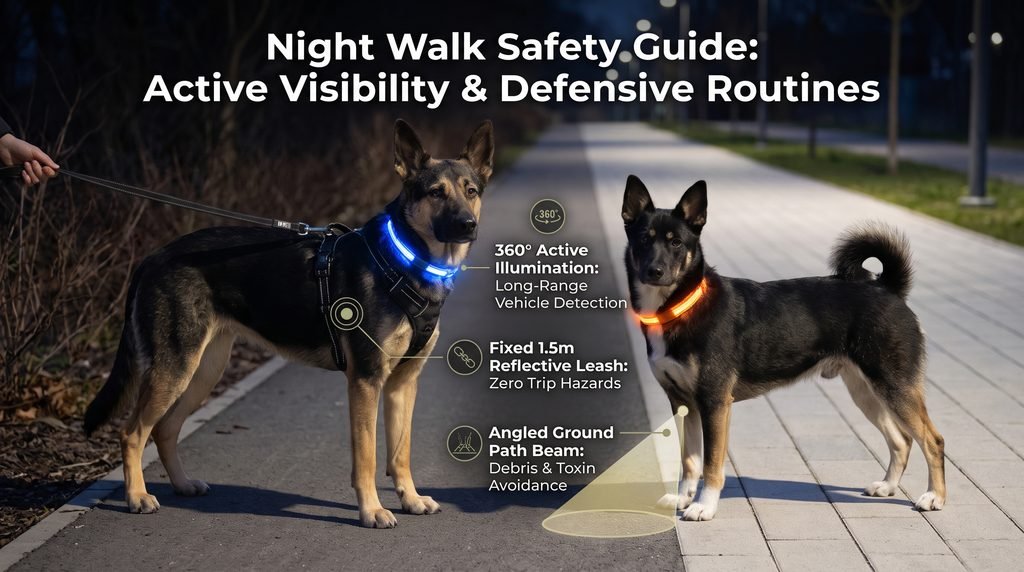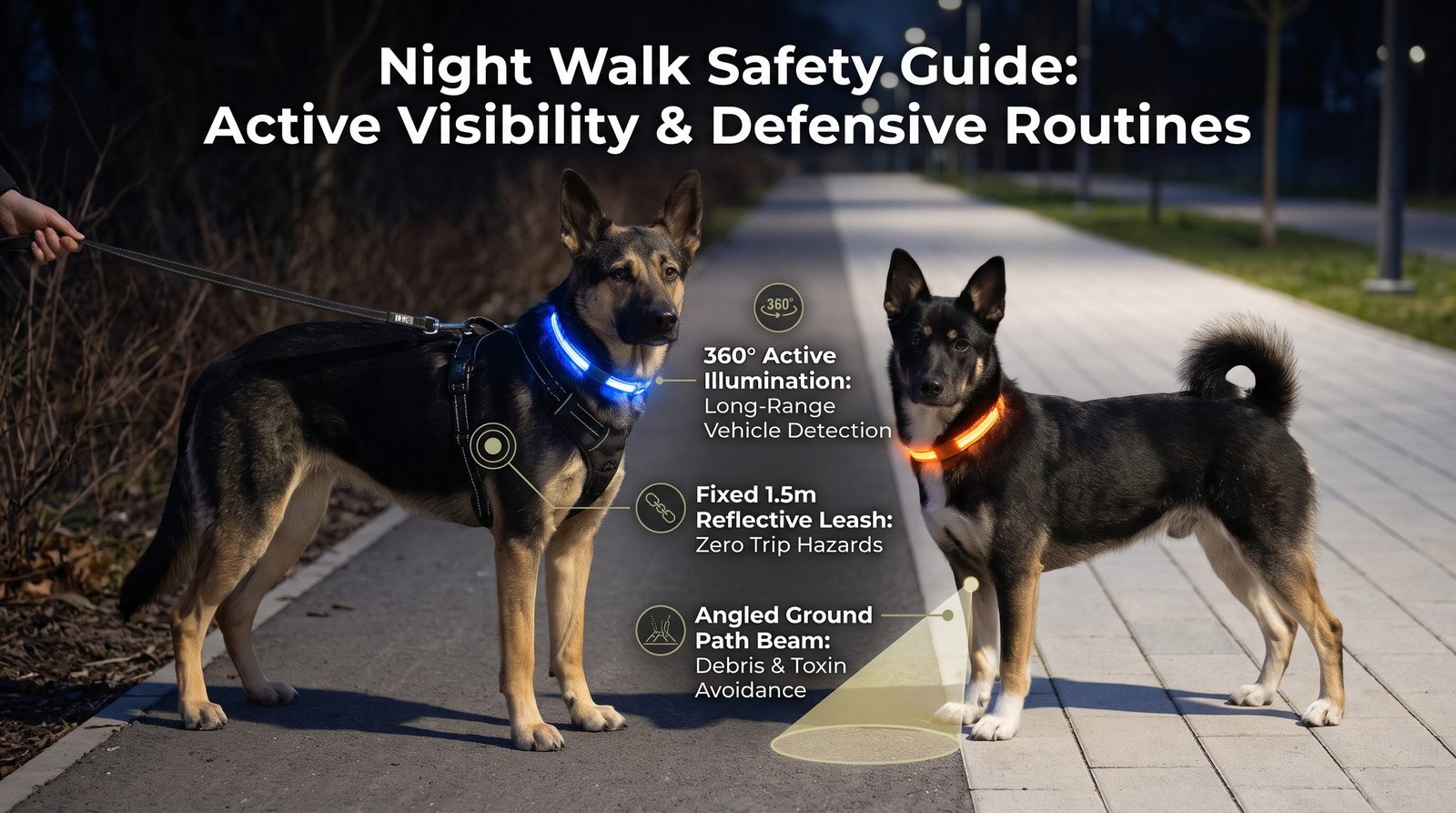
Prioritizing dog night walk safety is critical, as walking dogs after dark presents heightened hazards due to poor ambient visibility, delayed vehicle brake responses, and unpredictable pedestrian traffic. For dogs with dark coats or athletic, low-to-the-ground profiles, navigating unlit roads without multi-directional illumination exposes them to sudden collision risks. Ensuring complete safety requires moving beyond a standard flashlight to integrate active LED illumination, retroreflective textiles, and defensive walking mechanics designed to neutralize road hazards.
1. Environmental Hazards and Sensory Vulnerabilities After Sunset
Darkness impairs human depth perception and vehicle reaction windows. While dogs possess tapetum lucidum and a higher density of rod cells—allowing superior light gathering—they struggle with abrupt glare recovery and detailed object differentiation in dim environments.
The Invisibility of Dark-Coated Dogs
Dogs with black or dark bi-color coats blend seamlessly into nocturnal asphalt backgrounds. Standard vehicle low-beam headlights illuminate only 30 to 40 meters ahead. At 50 km/h (31 mph), a vehicle requires approximately 25 meters of stopping distance on dry roads. Without active illumination, a driver cannot identify a moving canine within a safe braking threshold.
Heightened Fear Responses and Visual Ambiguity
In the dark, commonplace objects like garbage bins, fluttering tarps, or individuals wearing hoods register as looming predatory threats to a dog’s vision. Sudden reactive lunging, defensive barking, and heightened alertness during night walks stem directly from incomplete visual confirmation and anxiety.
2. Multi-Point Visibility System: Technical Standards
Safely illuminating a dog requires a redundant configuration of active light emission and passive reflection visible from 360 degrees.
| Equipment Class | Recommended Technical Standard | Primary Protective Function | Suboptimal Choice |
| Active 360° LED Collar / Harness | IPX4 waterproof, continuous ring illumination, USB-C | 100m+ long-range peripheral recognition | Single-point directional pendant light |
| High-Grade Retroreflective Leash | Minimum 2cm width, dual-sided 3M threading | Delineates the handler-to-canine clearance line | Thin, unthreaded retractable cord |
| Hands-Free Angled Chest Light | 200–300 lumens, downwards tilt adjustment | Ground path illumination, clean waste collection | High-beam lamps pointing into canine eyes |
| Reflective Ankle Gaiters / Booties | Non-slip sole, secure hook-and-loop wrap | Protects against glass shards and road debris | Poorly fitted elastic bands prone to slipping |
Active Illumination vs. Passive Retroreflection
Passive retroreflective gear requires an external light beam (such as car headlights) to hit it at a direct angle. In urban alleyways or blind intersections, this leaves dogs completely invisible. Pairing a continuously glowing LED necklace (Active) with reflective harness webbing (Passive) guarantees multi-layered visibility across all angles.
Controlling Beam Lumens and Glare
Directing high-intensity headlamps into a dog’s face destroys dark adaptation and produces immediate disorientation. The handler’s secondary illumination must be angled downward at 45 degrees, projecting light strictly onto the immediate 2-meter radius ahead to identify road debris, broken bottles, or spilled waste.
3. Four-Step Defensive Walking Routine
Equipping visibility tools is only half the battle; handlers must execute systematic spatial control across high-risk urban sectors.
Step 1: Pre-Exit Gear Verification and Threshold Sit
Before crossing the threshold of your home, place your dog in a calm sit. Confirm that battery levels on all LED gear are fully charged and operating in solid-glow mode. Enforce a 5-second focus check at the doorway to extinguish impulsive lunging into the darkness.
Step 2: Enforcing a Strict 1.5-Meter Leash Radius
Critical Rule: Retractable tape leashes must never be used at night. In dim lighting, extended thin cord lines are invisible to cyclists and scooters, creating catastrophic trip-wire hazards. Maintain a fixed 1.5-meter leash held firmly against the handler’s hip to guarantee immediate evasion capability.
Step 3: Eliminating Unlit Foliage Encroachment
Unlit road verges and unmanaged brush frequently harbor broken glass, discarded food scraps, and rodent bait traps. Restrict off-path sniffing in unlit leaf drifts during night strolls; anchor your dog strictly to the center of well-lit concrete sidewalks.
Step 4: Blind-Corner Halt Discipline
Alleyway junctions and blind driveway corners represent high-impact hazard zones for delivery mopeds and electric scooters. Train a reliable “Halt” command 2 meters prior to any blind corner. The handler must step forward first, verify cross-traffic clearance, and only then signal the dog to proceed.
Frequently Asked Questions (FAQ)
Q1. Is a rapid strobe/flashing mode better than a solid glow for safety?
While flashing lights attract attention, continuous flashing causes sensory fatigue, disrupts canine peripheral vision, and can trigger agitation in neighboring dogs. A continuous solid-glow setting provides consistent distance tracking without causing spatial disorientation.
Q2. Why is my dog suddenly more reactive and vocal during night walks?
The loss of visual clarity forces dogs to rely heavily on hyper-sensitive hearing and scent detection, making them interpret ambiguous shadows as immediate threats. Do not correct forcefully; expand the distance from triggers, use a reassuring voice, and redirect their attention with calm engagement.
Q3. How can I manage nighttime waste pickup without losing control of the leash?
Utilize a hands-free chest harness light or a clip-on cap lamp to illuminate the ground directly while keeping both hands available. Pre-tear waste bags and loop them onto your wrist before exiting the house so you can secure waste smoothly while retaining firm grip on the leash.
Ultimately, mastering dog night walk safety requires deliberate, defensive walking mechanics to safeguard your companion. By pairing 360-degree active illumination with strict spatial boundaries and corner-clearing routines, you ensure that every evening outing remains secure, focused, and entirely hazard-free.
Meta Description:
Master night walk safety for dogs. Learn essential 360-degree LED gear setups, the danger of long leashes in the dark, and defensive 4-step street-walking routines.