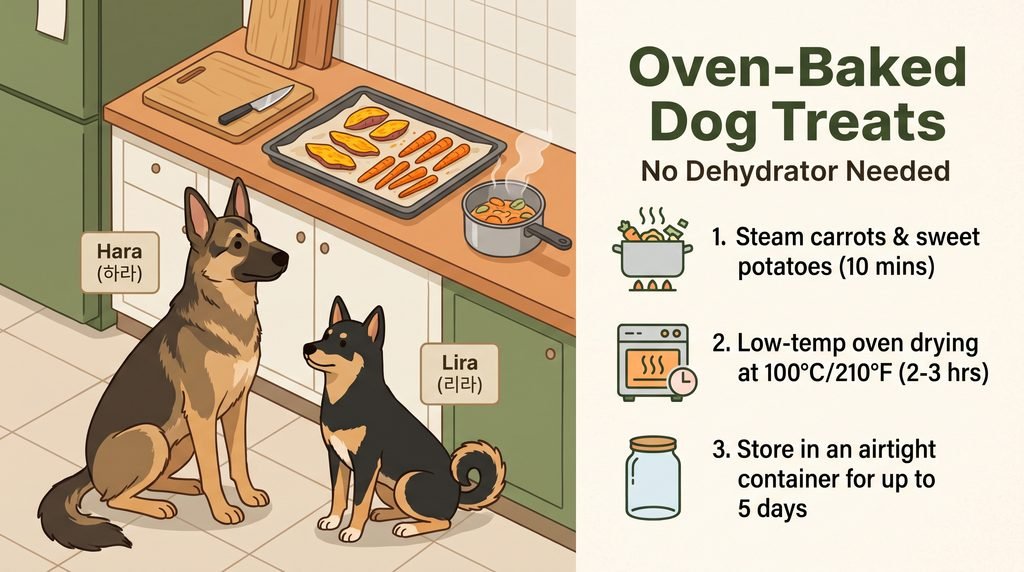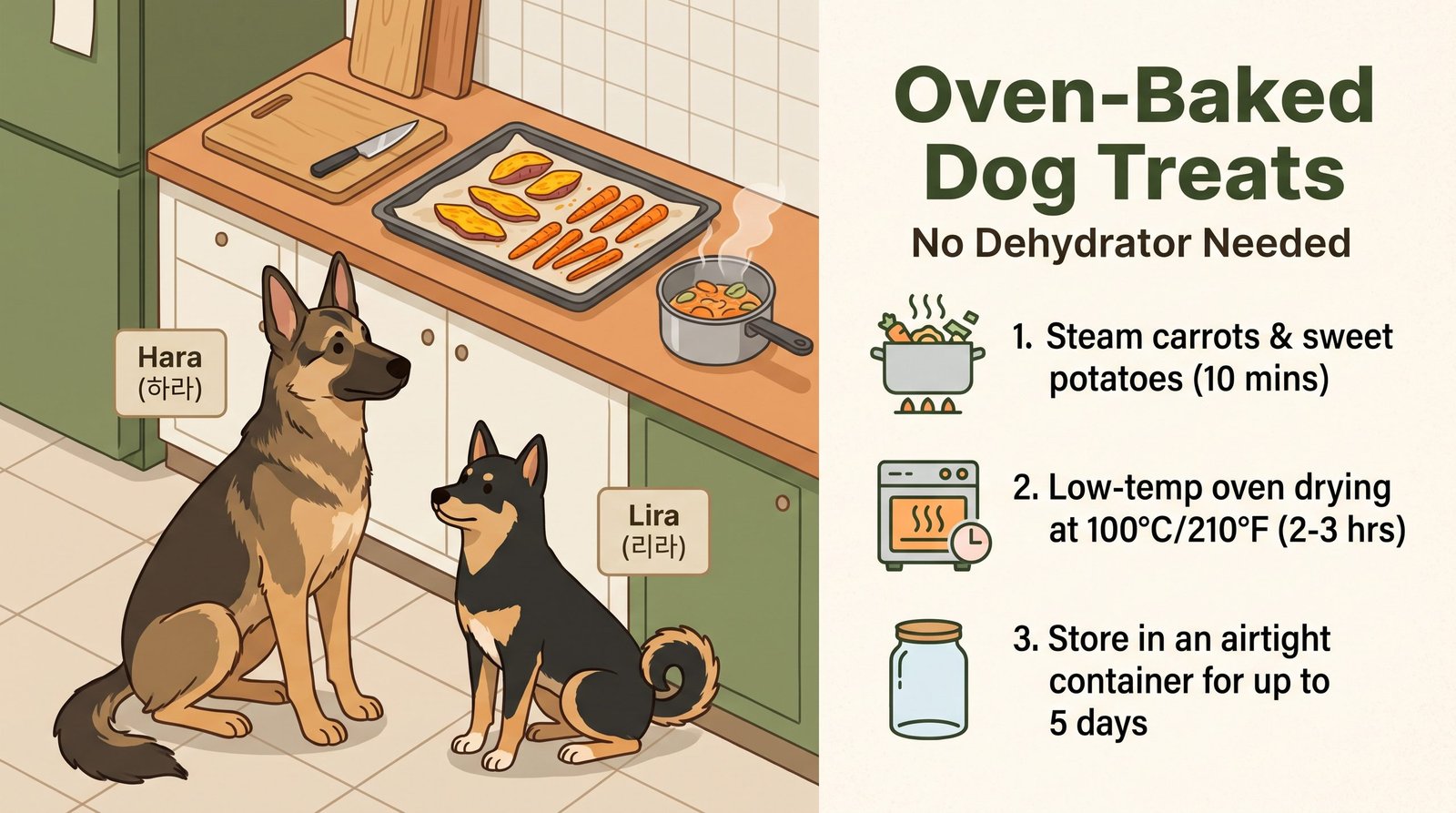
Commercial dog treats frequently contain chemical preservatives, artificial flavoring, and excessive refined starches that disrupt the canine gut microbiome and trigger allergic dermatitis. Making healthy homemade dog chews right in your kitchen completely eliminates these industrial additives, yet many pet owners hesitate due to the high cost of dedicated food dehydrators and their extensive 10-hour operating cycles.
By understanding the convection mechanics of a standard residential oven, you can create preservative-free, chewy vegetable treats in less than three hours. While carrots and sweet potatoes are packed with beta-carotene, dietary fiber, and essential minerals, raw vegetables have dense cellular structures that the canine digestive system cannot readily break down.
Inspired by the tailored care needed for large dogs like Hara (a German Shepherd mix with powerful jaws and high metabolic demands) and agile, medium breeds like Lira (a Shiba/Jindo mix requiring strict weight management), this guide breaks down the science of pre-steaming, low-temperature oven drying protocols, and portion controls for optimal bioavailability.
1. The Nutritional Science Behind Carrots and Sweet Potatoes: Why Pre-Steaming Matters
Feeding raw, dense root vegetables often results in visible whole chunks passing unabsorbed through a dog’s stool. The canine digestive tract lacks cellulase—the endogenous enzyme required to fracture tough plant cell walls.
Unlocking Micronutrients Through Controlled Thermal Breakdown
- Cellulose Softening: The structural rigidity of raw carrots traps beta-carotene inside microscopic vacuoles. Steaming them for approximately 10 minutes hydrolyzes the pectin bonds, loosening the fibrous matrix so digestive enzymes can extract internal nutrients.
- Bioavailability of Carotenoids: Beta-carotene is a fat-soluble precursor to Vitamin A. Mild heat treatment alters its crystalline structure into an accessible, bioavailable form easily absorbed into the bloodstream to support ocular and immune health.
- Starch Gelatinization in Sweet Potatoes: Raw sweet potato starch consists of tightly packed amylose crystals that ferment uncontrollably in the lower colon, causing intestinal gas and osmotic diarrhea. Steaming gelatinizes the starches, converting them into smooth, digestible complex carbohydrates.
2. Four-Step Protocol for Homemade Dog Chews in an Oven
Because residential ovens lack the constant passive venting found in food dehydrators, handlers must actively manage interior moisture dissipation and precise slicing geometry.
Step 1: Peeling and Structural Sizing
- Always peel the outer skin with a vegetable peeler to eliminate residual surface contaminants, waxes, and soil bacteria.
- Account for a 40–50% volumetric shrinkage during moisture evaporation:
- Small-to-Medium Dogs (Lira): Slice into 0.8 cm thickness x 5 cm length (creates a crisp, easily broken wafer).
- Large Working Breeds (Hara): Slice into 1.2 cm thickness x 7 cm length (yields a durable, rubbery dental chew).
Step 2: The 10-Minute Steam Blanch
Bring water to a rolling boil in a tiered steamer. Lay the vegetable batons in a single tier and steam with the lid on for 8 to 10 minutes. Test with a toothpick: the surface should yield smoothly while the core remains firm (al dente). Overcooking turns them into mush, making oven handling impossible.
Step 3: Oven Tray Alignment and Moisture-Venting Hack
- Line a heavy-duty baking sheet with unbleached parchment paper. Arrange the batons leaving at least 1 cm of negative space between each piece.
- Preheat the oven to 100°C (210°F), utilizing the convection fan setting if available. Never exceed 115°C (240°F), or the sugars will scorch rather than dehydrate.
- The Moisture Release Technique: Insert a heat-resistant silicone spatula or wooden chopstick into the top edge of the oven door to keep it propped open by approximately 0.5 cm. This crucial gap permits vapor escape, transforming the roasting oven into an active dehydrator.
Step 4: Dehydration and Turning Sequence (2.5 Hours)
- Total cooking time averages 2 hours and 30 minutes.
- At the 1-hour mark, pull the baking sheet out and flip every baton over to prevent localized condensation. Once the chews become leathery, pliable, and matte on the surface, power down the oven and let them cool inside the warm cavity for 30 minutes.
3. Nutritional Comparison and Oven Parameter Matrix
Carrots and sweet potatoes dry at different rates due to contrasting sugar and moisture densities. Use the following specifications to calibrate your bake:
| Parameter | Carrot Chews | Sweet Potato Chews |
| Primary Nutritional Benefit | Beta-carotene, Lutein, Insoluble fiber | Complex carbs, Potassium, Vitamins B6 & C |
| Optimal Pre-Steam Duration | 8 minutes (maintains structural integrity) | 10 minutes (ensures complete gelatinization) |
| Oven Drying Time at 100°C | Approx. 2 hours (lower intrinsic sugar) | 2.5 to 3 hours (higher sugar condensation) |
| Finished Texture | Firm, semi-rigid crunchy wafer | Tough, leathery, flexible jerky stick |
| Airtight Refrigerated Shelf Life | 5 to 7 days | 4 to 5 days (higher moisture/sugar retention) |
4. Size-Specific Portioning Guidelines and Preservation
Zero-preservative natural treats spoil quickly if exposed to ambient humidity.
Daily Portion Control by Canine Weight Class
Treats must never exceed 10% of your dog’s total daily caloric expenditure.
- Large Dogs (Hara’s profile / 25–30 kg): Up to 2–3 sweet potato chews and 3–4 carrot sticks per day.
- Medium Dogs (Lira’s profile / 10–15 kg): 1 sweet potato chew and 1–2 carrot sticks per day. Because dehydration condenses simple starches into concentrated sugars, restrict sweet potato portions for dogs prone to excess weight.
Mold Prevention and Storage Strategy
- Allow the chews to cool down to ambient room temperature on an elevated wire rack for at least 45 minutes. Trapping residual heat in a closed container generates immediate condensation, inducing mold formation within 48 hours.
- Keep a 3-day supply in a glass mason jar with a food-grade silica packet in the refrigerator. Store remaining batches in portioned freezer bags for up to 3 months. Thaw at room temperature for 15 minutes before serving to avoid stomach chill.
Frequently Asked Questions (FAQ)
Q1: Can I bypass the steaming phase and put raw slices directly into the oven? Directly drying raw vegetables dries out the exterior while trapping raw, ungelatinized starch inside. This leaves the chew brittle, unpalatable, and biologically indigestible, often leading to gastric upset and loose stools. Gentle steaming is a mandatory step for canine nutrient absorption.
Q2: Are dried sweet potato chews safe for dogs with diabetes or pancreatitis? Dehydrating sweet potatoes significantly raises their glycemic index due to concentrated maltose sugars. Dogs diagnosed with canine diabetes or acute pancreatitis should strictly avoid sweet potato chews; small portions of steamed carrot chews remain a much safer, low-glycemic alternative under veterinary supervision.
Q3: Can I adapt this method using an air fryer instead of an oven? Yes, but air fryers concentrate heat much closer to the food. Lower the temperature setting to 80°C–90°C (175°F–195°F) and shake the basket every 15 minutes. The total dehydration time will decrease to approximately 60 to 75 minutes.
Eliminating store-bought chemical preservatives does not require expensive kitchen gadgets. With a ten-minute steam prep, calibrated oven venting, and tailored sizing, you can provide premium dental chews for your companions. Tailor thicker, rubbery sweet potato jerky for large, energetic chewers like Hara, and crisp, easily digested carrot sticks for nimble, focused dogs like Lira to support their lifelong vitality.
Meta Description:
Learn how to make homemade carrot and sweet potato dog chews using a regular oven without a dehydrator. Detailed steaming times, venting tricks, and canine feeding sizes.