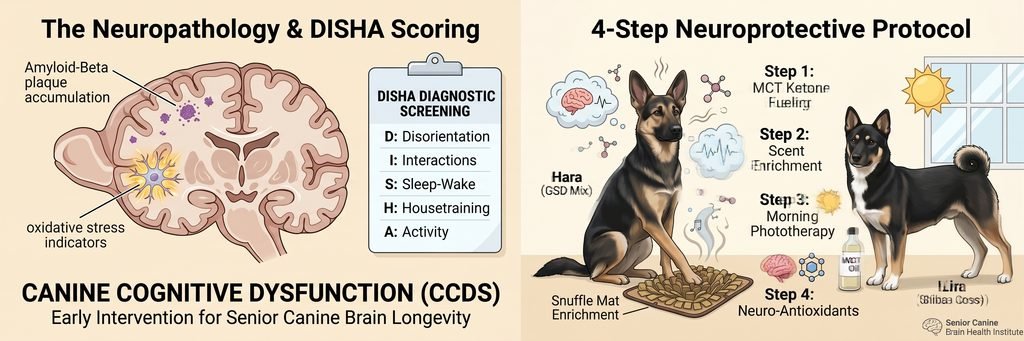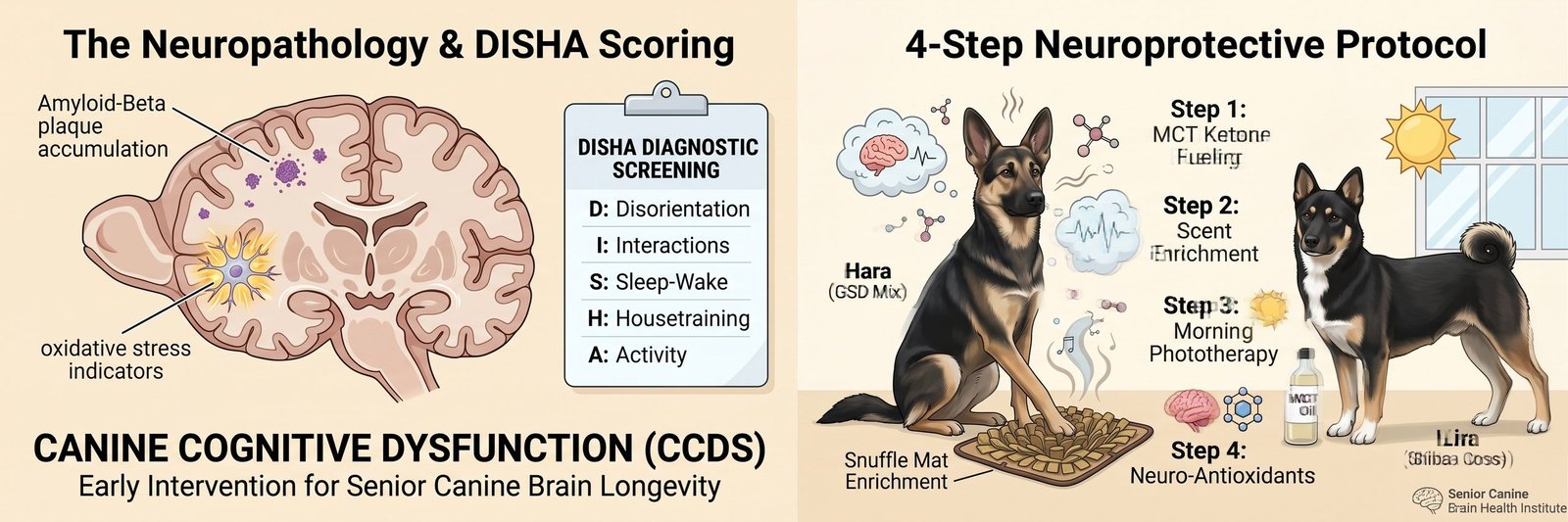
Canine cognitive dysfunction symptoms represent far more than benign behavioral quirks of old age; they are the external hallmarks of Canine Cognitive Dysfunction Syndrome (CCDS), an irreversible, progressive neurodegenerative disease pathologically parallel to human Alzheimer’s disease. Epidemiological data indicates that 14% to 35% of dogs aged 8 and older suffer from CCDS, with prevalence exceeding 60% in canines past age 15. Tragically, owners frequently misattribute pacing at dawn, vocalization, or corner entrapment to “stubborn senescence,” forfeiting the critical window for therapeutic intervention. As toxic insoluble amyloid-beta ($A\beta$) oligomers aggregate across the cerebral cortex and neuronal glucose transport collapses, older dogs experience sleep-wake cycle inversion, elimination breakdowns, and acute separation panic. For agile German Shepherd crosses (Hara archetype) possessing high exploratory drives and independent Shiba crosses (Lira archetype) with sharp environmental vigilance, proactive sensory and mitochondrial support constitutes the ultimate determinant of neurological longevity.
Neuropathology and Cerebral Mitochondrial Energy Starvation
While the canine brain accounts for barely 2% of total body weight, it consumes over 20% of resting glucose and oxygen. CCDS progression is intrinsically driven by bioenergetic failure, where neurons starve in the midst of metabolic starvation.
1. Amyloid Oligomerization and Microglial Cytotoxicity
- Synaptic Architecture Blockade: Neurotoxic amyloid-beta peptides aggregate into senile plaques within the neuropil, severing chemical neurotransmission across cortical and hippocampal synapses.
- Chronic Neuroinflammation: Inability of cerebral microglia to clear these dense fibrillar aggregates triggers continuous secretion of tumor necrosis factor-alpha (TNF-$\alpha$) and reactive oxygen species (ROS), causing bystander injury to neighboring healthy neurons.
2. Microvascular Sclerosis and Glucose Deprivation
- The Metabolic Brownout: Progressive cerebral amyloid angiopathy thickens capillary basements, reducing blood perfusion. Downregulation of critical glucose transporters (GLUT-1 and GLUT-3) strips neurons of their primary glycolytic substrate, resulting in chronic bioenergetic failure and synaptic collapse.
Clinical DISHA Assessment Matrix for Veterinary Staging
Veterinary behavioral neurology utilizes the validated DISHA Framework to quantify neurological decline and guide clinical staging.
| Clinical Dimension (DISHA) | Early Neurodegenerative Clues (Mild) | Advanced CCDS Hallmarks (Severe) | Targeted Veterinary Objective |
| D (Disorientation) | Pausing hesitantly at the hinge side of an open door | Compulsive head-pressing against walls or furniture corners | Stabilize spatial anchors; eliminate room rearrangements |
| I (Interactions) | Delayed greeting latency when family members arrive | Unprovoked social avoidance or defensive irritability upon handling | Establish predictable, non-confrontational safety retreats |
| S (Sleep-wake inversion) | Extended diurnal somnolence paired with shallow micro-naps | Nocturnal pacing, distress howling, and staring into open space | Circadian phototherapy and melatonin chronoregulation |
| H (Housetraining loss) | Peripheral urination missing the puppy pad by inches | Inability to signal elimination needs; defecating on sleeping beds | Wide-area fluid-impervious padding and scheduled walks |
| A (Activity & Anxiety) | Decreased tactile exploration of enrichment toys | Stereotypic compulsive circling or aimless wandering | Neuro-antioxidant supplementation and scent work |
Veterinary Neurology Warning: Abrupt behavioral shifts, persistent head tilts, or rigid head-pressing can signify acute structural intracerebral lesions (e.g., meningioma, pituitary macroadenoma) or hepatic encephalopathy. Comprehensive serum biochemistry, blood pressure assessment, and magnetic resonance imaging (MRI) should precede definitive CCDS diagnosis.
4-Step Neuroprotective & Cognitive Preservation Protocol
While destroyed neural architecture cannot be regenerated, optimizing remaining synaptic plasticity and supplying alternative mitochondrial fuels can decisively decelerate cognitive collapse.
- Mitochondrial Ketogenic Energy Switching (Targeted MCT Administration): Because aging canine neurons lose the capacity to metabolize glucose, medium-chain triglycerides (predominantly pure C8 caprylic and C10 capric fatty acids) provide an indispensable bypass fuel. When metabolized by hepatic beta-oxidation, MCTs convert into ketone bodies ($D\text{-}\beta\text{-hydroxybutyrate}$ and acetoacetate), crossing the blood-brain barrier to fuel mitochondrial ATP synthesis directly. Initiate dosing at 1 ml per 10 kg daily, titrating slowly with meals.
- Sensory Olfactory Bulb Mobilization (Neuro-Enrichment): Even as visual and auditory pathways deteriorate, the primary olfactory cortex and limbic projections remain remarkably intact. Engage the senior canine in daily 15-minute scent-work exercises using multi-layered snuffle mats, foraging puzzles, and novel botanical scents to stimulate adult neurogenesis within the subventricular zone.
- Circadian Entrainment via Morning Phototherapy (SCN Reset): To arrest severe nocturnal pacing, expose the dog to natural morning sunlight for at least 20 minutes prior to 09:00 AM. Photons strike retinal ganglion cells projecting directly to the hypothalamic suprachiasmatic nucleus (SCN), resetting circadian oscillations and boosting natural evening melatonin synthesis for deep slow-wave rest.
- Multi-Target Neuro-Antioxidant Sealing: Implement daily administration of concentrated marine Omega-3 DHA (docosahexaenoic acid), which maintains neuronal membrane fluidity. Complement this with S-adenosylmethionine (SAMe), Ginkgo biloba standardized extract (for cerebral vasodilation), and natural d-alpha-tocopherol to neutralize oxidative cascades and shield fragile microvascular networks.
Frequently Asked Questions (FAQ)
Q1. My senior dog paces and cries all night; can I administer over-the-counter sleep aids?
Never administer human sleep medications or sedatives without explicit veterinary supervision. Human formulations can induce paradoxically heightened agitation, hepatic necrosis, or fatal respiratory depression in geriatric dogs. Furthermore, heavy sedatives worsen nocturnal disorientation and delirium. Have your veterinarian evaluate the dog for silent osteoarthritic pain, and discuss tailored canine formulations such as low-dose veterinary melatonin, L-theanine, or targeted GABA-ergic modulators.
Q2. Is it safer to discontinue walks if my dog appears confused outside?
No. Complete physical isolation causes severe sensory deprivation, dramatically accelerating cognitive decline. Provided physical mobility allows, maintain low-velocity strolls through quiet, familiar environments. If ambulation is physically limited, utilize a pet stroller to facilitate “sensory walking,” allowing outdoor wind currents, ambient scents, and changing temperatures to stimulate dormant sensory cortices.
Q3. Can I use ordinary commercial human cooking coconut oil as an MCT source?
Standard culinary coconut oil contains predominantly lauric acid (C12), which behaves biochemically like a long-chain fatty acid and generates minimal ketone yields. Optimal neuroprotective benefits require pure veterinary-grade or pharmaceutical-grade liquid MCT oil concentrated in C8 (caprylic acid) and C10 (capric acid), completely free of added flavorings, preservatives, or artificial sweeteners such as xylitol.
Proactive cognitive care transforms the golden years of a senior canine from confusing twilight into a peaceful, dignified journey. Screen for early DISHA markers, ignite dormant cerebral mitochondria with targeted nutrition, and safeguard your companion’s memory.
- Meta Description: Identify subtle canine cognitive dysfunction symptoms through the clinical DISHA scoring matrix. Master a 4-step neuroprotective protocol with MCT and enrichment.