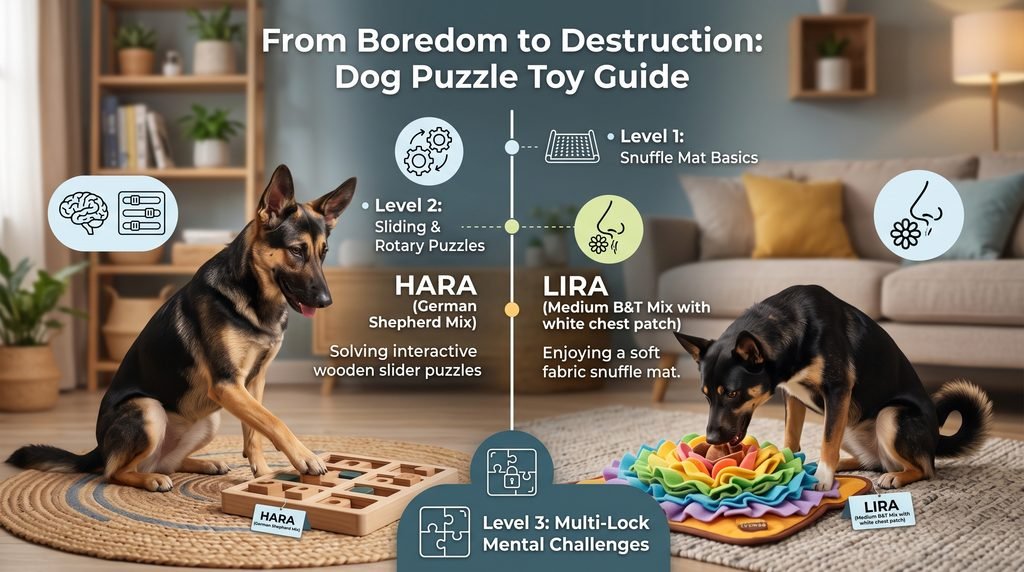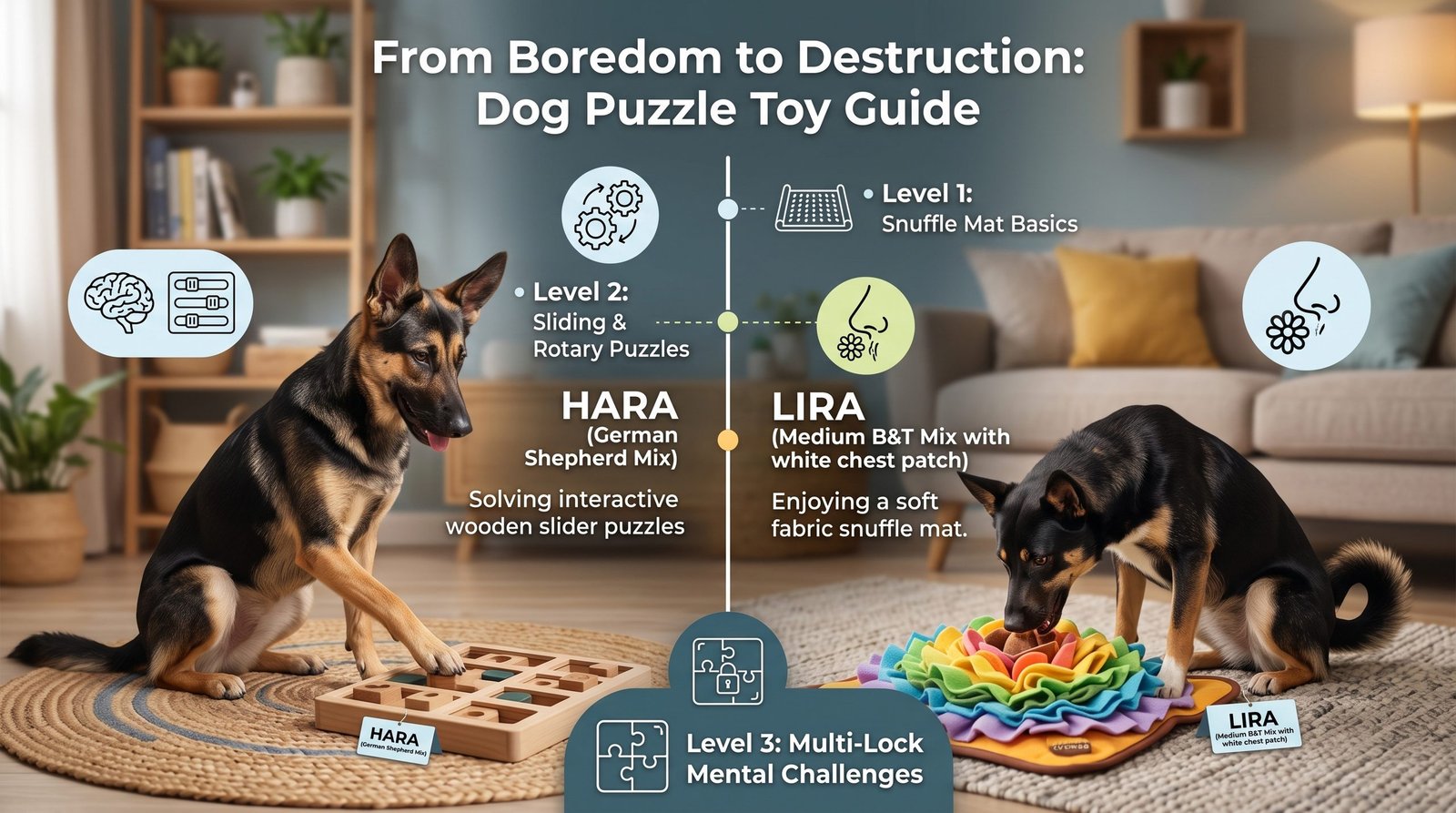
Torn drywall, gnawed baseboards, and upended trash bins discovered after returning home are rarely acts of spite or dominance. When a canine brain experiences chronic under-stimulation and mental barrenness, destructive chewing becomes a neurological coping strategy to manufacture dopamine. Introducing the right dog puzzle toys provides essential mental stimulation, but scaling their difficulty properly is critical to prevent frustration.
Canines possess an evolutionary drive for olfactory exploration and tactical problem-solving. However, introducing an overly intricate puzzle creates intense frustration—often causing the dog to simply chew the plastic unit to pieces. Conversely, overly simplistic setups are solved within ninety seconds, sending the dog right back to furniture destruction.
This guide dissects the relationship between canine cognitive depletion and property damage, providing a clinical framework to scale mental enrichment from rudimentary scent games to multi-tiered brain teasers.
1. The Neurobiology of Canine Boredom and Destructive Chewing
Daily canine fatigue relies on two balanced operational pillars: physiological exertion and deep cognitive expenditure.
How Olfactory Scentwork Rebalances the Canine Nervous System
- Cortisol Downregulation via the Olfactory Bulb: Scent tracking directly engages extensive neural architecture within the canine brain, triggering parasympathetic activation, slowing cardiac rate, and lowering baseline cortisol.
- Cognitive Caloric Burn: Twenty minutes of intense spatial scent analysis and fine-motor puzzle extraction burns more neurological energy than a continuous 60-minute monotonous leash walk.
- Oral Fixation Redirection: Chewing furniture fulfills an unmet jaw compression drive. Engaging puzzle mechanisms satisfies this oral fixation, redirecting biting pressure away from household fixtures.
2. A Systematic 3-Tier Difficulty Scaling Framework
The foundational golden rule of cognitive canine enrichment is “Preserving an 80% Success Rate.” Consistent rewards prevent destructive frustration while building persistent focus.
| Difficulty Tier | Core Tooling | Mechanics | Target Behavioral Profile |
| Level 1: Foundational Scenting | Fleece snuffle mats, crinkled cardboard boxes | Direct olfactory location with instant payout | Beginners, rescue dogs with elevated anxiety |
| Level 2: Primary Mechanical Shifting | Sliding covers, rotating disc apparatuses | Paw or muzzle pushes, directional nudges | Dogs solving basic mats in under 3 minutes |
| Level 3: Sequential Locking Brain Teasers | Pull-pin releases linked to drawer sliders | Removing blocker pegs to unlock lower tiers | High-drive working breeds, agile problem solvers |
Level 1: Immediate Gratification & Confidence Building (Snuffle Mats)
- Configuration: Scatter high-value, aromatic morsels atop the fleece folds rather than tucking them deep inside.
- Pro-Tip: Allow the dog to establish a seamless connection between sniffing and dopamine gratification before progressively burying treats into tighter fabric knots over consecutive days.
Level 2: Mechanical Cause-and-Effect (Sliders & Rotating Discs)
- Configuration: For sliding tile boards, leave compartments half-open initially, keeping the reward visible and easily accessible.
- Pro-Tip: Ensure minimum sliding friction so that an incidental nose or paw bump immediately slides the tile and yields the treat.
Level 3: Sequential Multi-Lock Challenges (Advanced Wooden/Plastic Puzzles)
Precaution: The predominant failure point at Level 3 is destructive jaw force cracking the plastic casing due to barrier frustration.
When a dog must extract a top peg to free an underlying sliding drawer, you must actively assist and demonstrate the vertical pull for the first several repetitions. Intervene instantly if chewing replaces manipulation, guiding the dog back to structural solutions.
3. High-Risk Enrichment Pitfalls to Avoid
- Unsupervised Initial Exposure: Leaving an unaccustomed dog alone with an advanced puzzle induces frantic tearing, which often leads to plastic ingestion hazards or foreign body emergencies.
- Nutritional Surplus from High-Calorie Treats: Intensive mental sessions consume dozens of reinforcement bits. Replace fatty commercial treats by reserving 50% of their daily balanced kibble allocation for puzzles, or use micro-diced freeze-dried single proteins.
- Toy Stagnation and Learned Monotony: Presenting the same puzzle daily converts cognitive exploration into a mindless mechanical reflex. Rotate a collection of 3 to 4 distinct puzzle mechanics throughout the week to sustain neuroplastic engagement.
4. Frequently Asked Questions (FAQ)
Q1. My dog flips the entire puzzle board over with their paw instead of sliding the pieces. Should this be stopped?
No. Flipping the board is an innovative display of physical problem-solving. However, to cultivate fine-motor cognitive discipline, mount the puzzle on a non-skid silicone base or weight the tray down so they must operate the mechanical sliders.
Q2. Can nosework over-arouse excitable dogs?
If a dog searches fruitlessly for over 10 minutes, dopamine depletion triggers frantic agitation. Restrict enrichment bouts to 15–20 minutes and conclude with an effortless find so your dog finishes in a satisfied, resting state.
Mental enrichment tools are therapeutic instruments that reawaken ancestral foraging instincts while restoring domestic calm. Lower the difficulty threshold today, build your dog’s confidence, and watch destructive boredom disappear.