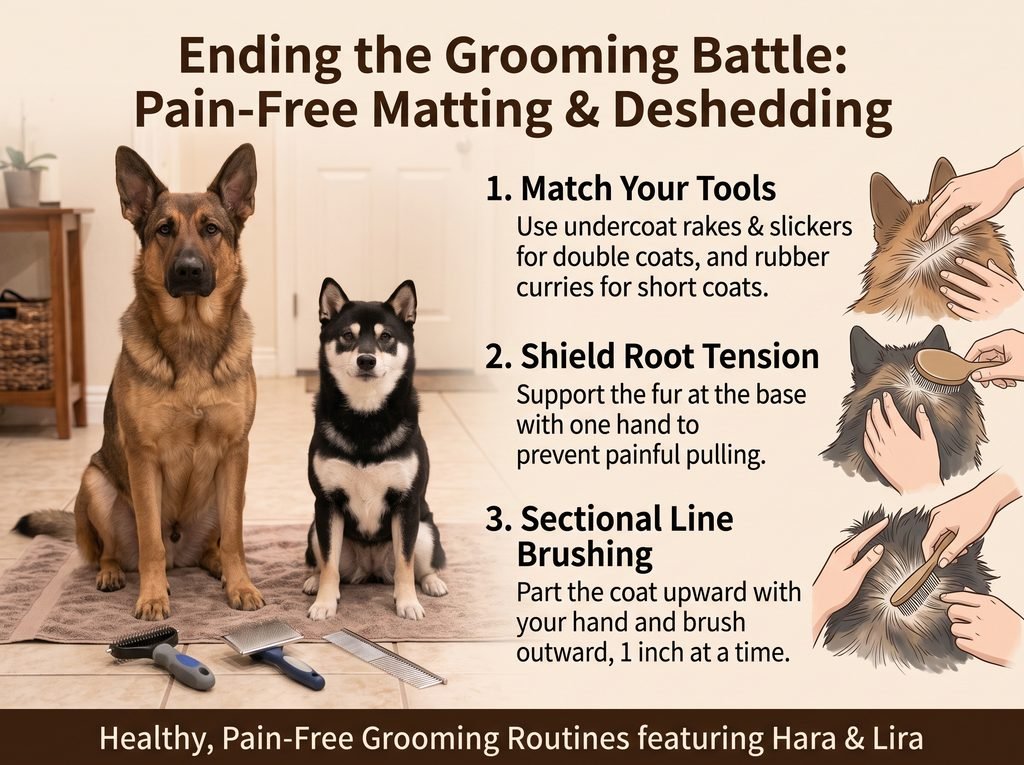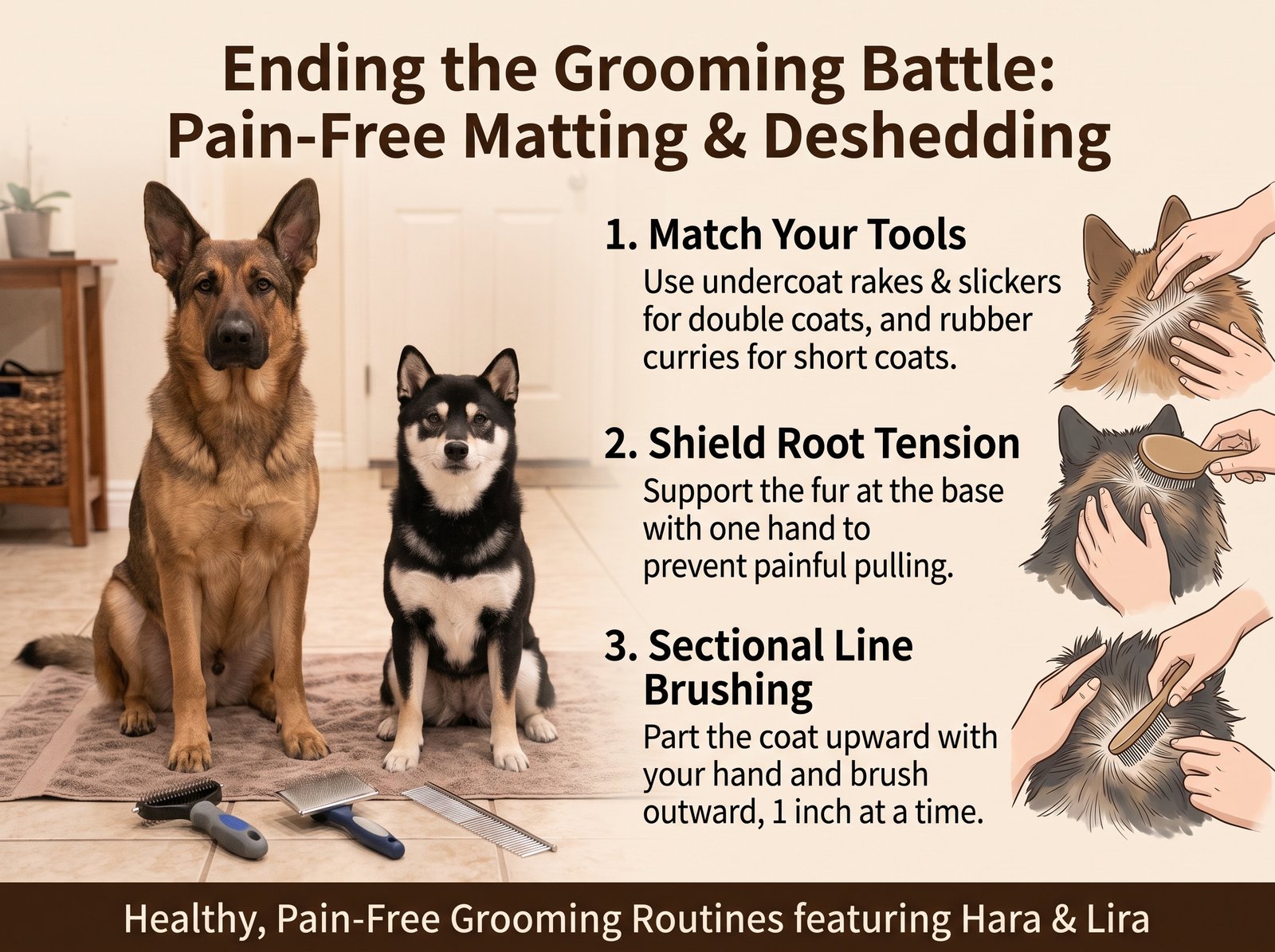
Growling, evasion, and defensive mouthing when a brush appears are rarely signs of disobedience. Instead, they are direct physiological defense mechanisms against “brush burn”—severe micro-abrasions caused by improper pin angles—and the agonizing traction pain of tangled hair being wrenched from the skin.
Double-coated breeds like German Shepherd crosses and Shiba or Jindo mixes trap immense volumes of shed undercoat close to the dermis. If left unmanaged, this dead hair obstructs cutaneous respiration and fosters acute moist dermatitis (hot spots). Conversely, short-coated canines demand friction-free tools that stimulate sebum distribution without bruising the epidermis.
Here is an evidence-based grooming protocol covering tailored tool selection, painless deshedding, and precise undercoat aeration.
1. Selecting Grooming Tools Based on Coat Architecture
Applying a single brush across distinct coat types without recognizing dermal layers is the primary cause of epidermal trauma and behavioral grooming aversion.
Physiological Anatomy and Tool Coordination
- Double-Coated Architecture: Composed of harsh, weather-resistant guard hairs that protect an insulating, downy undercoat. Effective deshedding requires an undercoat rake to extract trapped dead hairs, a long-pin slicker brush to untangle knots, and a stainless steel greyhound comb to verify complete root clearance.
- Short-Coated Anatomy: Features a single layer of short hair with minimal dermal shielding against rigid metal implements. Wire slickers must be swapped for vulcanized rubber curry brushes or natural boar bristle tools that massage subcutaneous microcirculation and spread protective natural lipids evenly.
2. Comparative Matrix: Tool Function and Application Frequency
Matching tool tooth depth to coat density protects vulnerable skin surfaces while maximizing shedding reduction.
| Coat Category | Primary Tool | Mechanical Function | Cadence | Precautionary Rule |
| Double Coat (Undercoat) | Undercoat Rake | Hooks and clears dead, compacted undercoat fibers | 2–3x weekly (4x during shed season) | Never press directly against bony joints |
| Double Coat (Verification) | Greyhound Steel Comb | Detects residual micro-tangles at the follicular base | Immediately following every rake session | Never force teeth through a snag |
| Short Coat (Sebum & Dander) | Rubber Curry Brush | Traps loose hair, exfoliates dander, stimulates blood flow | 1–2x weekly | Work in gentle circular motions |
| All Breeds (Matting) | Dematting Rake | Slices through dense felted hair knots | Spot-treatment only | Keep cutting blades angled safely off the skin |
3. The 3-Step Painless De-Matting and Line Brushing Protocol
Raking a brush vertically down the entire length of a dog’s body is the most common home-grooming error; it merely skims top guard hairs while leaving deep undercoat mats untouched.
Step 1: Hydration and Root Tension Shielding
Dry hair fibers generate electrostatic friction that snaps hair shafts and pinches nerve endings. Mist a light moisturizing detangling spray 12 inches above the coat. When addressing an established knot, pinch the fur firmly at its base between your thumb and forefinger to absorb all mechanical tension, protecting the skin from pull.
Step 2: Sectional Line Brushing
Part the fur upward with your non-dominant hand until a distinct line of bare skin is clearly visible. With your brush hand, work through small 1-inch sections from the root outward, utilizing short, curved wrist flicks. This flicking motion guarantees pins slide parallel through the coat rather than scraping the dermal layer.
Step 3: Zero-Resistance Comb Verification
The Clinical Standard: Following line brushing, guide a stainless steel greyhound comb tilted at a 45-degree angle through high-friction zones—specifically behind the ears, armpits, and rear flanks. The comb teeth must glide unimpeded from root to tip; any resistance indicates unextracted dead undercoat.
4. High-Risk Grooming Pitfalls to Avoid
- Bathing Prior to Full Detangling: Exposing matted fur to warm water and shampoo causes wet fibers to shrink and felt together like solid wool, requiring surgical clipping. Every mat must be completely removed prior to getting wet.
- Shaving Double Coats: Clipping double coats to mitigate shedding destroys natural thermal barrier mechanisms and invites post-clipping alopecia, where follicles fail to regenerate viable guard hair.
- Repetitive Single-Zone Friction: Repeatedly brushing the same patch of skin more than 8 to 10 times causes severe erythema and friction dermatitis. Rotate continuously between anatomical sectors.
5. Frequently Asked Questions (FAQ)
Q1. My dog bites the brush instantly. How do I desensitize this reaction?
Pair the physical tool with high-value reinforcement before brushing ever begins. Place the brush on the floor and reward investigative sniffing. Next, touch your dog’s flank with the smooth back of the brush and immediately feed a high-value treat. Limit early sessions to five seconds of actual brushing, expanding duration only as comfort is demonstrated.
Q2. Are slicker brushes with protective plastic-tipped balls gentler on canine skin?
No. In dense double coats, plastic coated tips snag on undercoat fibers and tear hair out at the root, generating sharp pain. Select professional-grade, tip-free stainless steel slickers with flexible cushions, testing the tool against your own inner forearm first to calibrate gentle pressure.
Brushing is a daily health screening that bonds you to your dog while monitoring skin integrity. Soften your grip, isolate the hair roots with your fingers, and transform daily brushing into a relaxing, pain-free routine.
- Meta Description: Master canine brush selection for double and short coats with a clinical line-brushing protocol that eliminates brush burn and painful matting.