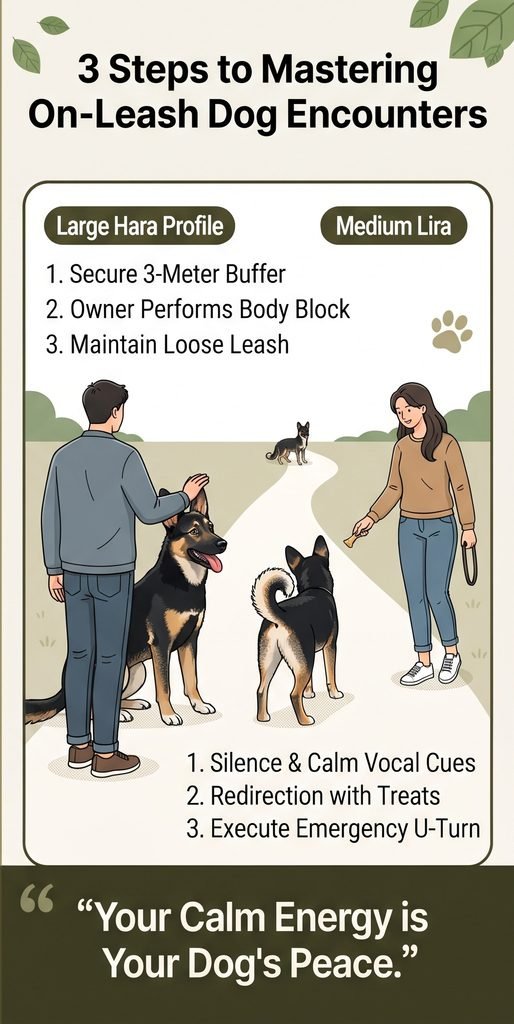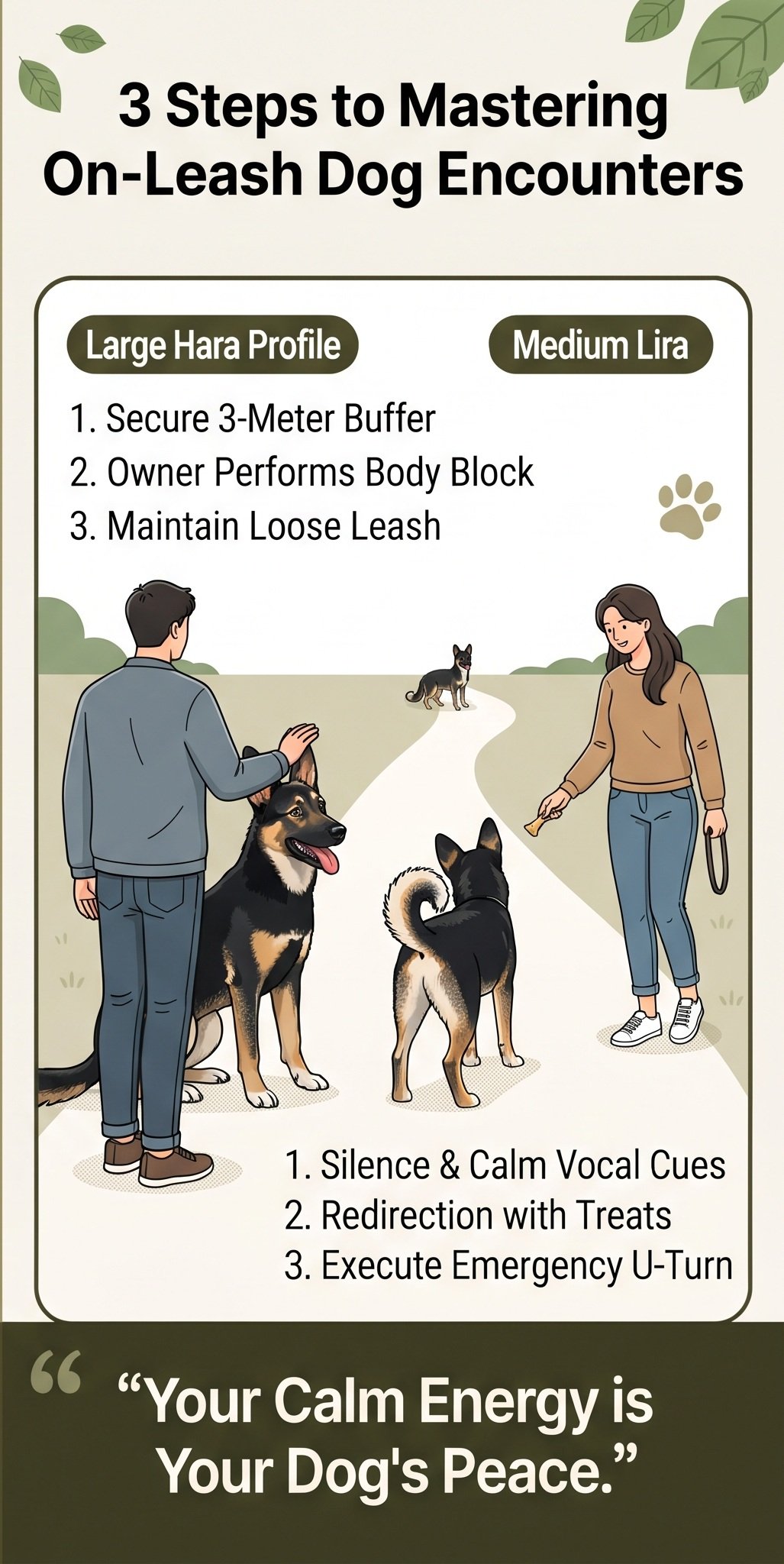
Walking your dog should be a pleasure, but mastering on-leash dog interactions is essential when unfamiliar dogs appear on the horizon, many owners tense up, fearing a reaction. This is especially true for large, high-energy Shepherd mixes like Hara, or naturally wary Black-Tan mixes like Lira, who can quickly become overwhelmed and reactive. Improper reactions—yelling “It’s okay!” or tightening the leash—inadvertently escalate the tension. This guide provides a structured, psychology-based protocol to manage your dog’s energy, maintain control, and ensure a peaceful encounter.
H2. 1. The Art of Proactive Prevention: Distance and Blocking
The best reaction is no reaction at all. The golden rule of responsible dog walking is establishing a ‘safe buffer zone.’
H3. 1.1 The 3-Meter Rule and Strategic Re-routing
Upon spotting another dog, instantly create a minimum of 3 meters (approx. 10 feet) of space. If you’re on a narrow path, do not hesitate to turn around entirely or duck behind a parked car or into a driveway. For a large dog like Hara, the owner’s body can serve as an effective visual block to prevent intense direct eye contact.
H3. 1.2 Redirection Before Reaction
The moment your dog notices the other dog and goes still or starts to stare intently, forcing them away by pulling the leash will trigger their opposition reflex, intensifying their desire to react. Instead, you must utilize prior training. Use a pre-learned recall cue or lure them with a high-value treat right at their nose to break their focus and shift their attention back to you.
| Scenario | Recommended Owner Action | Dog’s Likely Emotional State |
| Spotting a Dog Far Off | Immediately yield; maintain/increase distance | Curiosity or mild alert |
| Encountering on Narrow Path | Move to the side, utilize body block | Rising tension, potential defense |
| Approaching Dog Directly | Politely ask owner to wait; create space | Increased anxiety, potential aggression |
H2. 2. Managing the Moment: The Owner’s Calming Energy
Your dog is an emotional mirror. If you are anxious, your dog will become reactive. Before you can calm your dog, you must calm yourself.
H3. 2.1 The Loose Leash Principle
A tight leash screams “danger” to your dog. They interpret the tension as a signal that you are preparing to fight. Even if you’re nervous, keep your hand steady at your waist and maintain slack in the line. A loose leash communicates confidence, helping sensitive dogs like Lira remain calm.
H3. 2.2 Silence is Golden
Yelling “No! Quiet!” is utterly ineffective. In their heightened state, your dog cannot process human language; they only perceive your agitated tone, which encourages them to join in the “noise.” Instead, offer gentle, silent reassurance. A slow, deep stroke on the shoulder or a calm whisper of “we’re okay” demonstrates leadership.
Expert Insight:
“The biggest mistake owners make when encountering another dog is surrendering their leadership role and reacting to their dog’s reaction. Your dog does not need you to escalate; they need you to lead them to safety.”
H3. 3. The Emergency Exit: Executing a Safe Retreat
If you have remained calm but the situation continues to escalate, you must disengage immediately and decisively.
H3. 3.1 Executing the Emergency U-Turn
When facing an oncoming reactive or aggressive dog, avoid a standstill showdown. Perform an immediate about-face and run or briskly jog in the opposite direction. Your dog is hardwired to follow pack movement. By quickly retreating and enthusiastically calling “Let’s go!” while bringing your leash hand toward your body, you motivate your dog to follow you away from the threat.
H3. 3.2 Three Mistakes to Never Make
- Lifting Your Dog: Even if your dog is medium-sized, lifting them leaves them vulnerable and maximizes their terror while potentially redirecting aggression onto you.
- Forcing an Introduction: Never allow your dog to approach another on a tight leash, and never engage in small talk while the dogs sniff nose-to-nose. This prolonged proximity breeds tension.
- Punishing the Growl: Suppressing a growl removes your dog’s only warning signal, causing them to go straight to biting without warning. Address the underlying anxiety, not the communication.
FAQ
- Q1. My dog is friendly, but the other dog is barking wildly. What do I do?
- Reactivity is contagious. Even if your dog is social, the safest action is to ignore the barking dog and move past the situation quickly to prevent your dog from learning to react similarly.
- Q2. What is the recommended leash length for daily walks?
- For standard neighborhood walks, a fixed-length, non-retractable leash of 2 to 3 meters (approx. 6-10 feet) offers the best balance of freedom and control in unexpected situations.
Action Guide
Starting today, designate three spots during your walk to practice “sit” and “watch me.” When you next spot a dog, instead of tightening the leash, immediately reach into the treat pouch you’ve prepared in your pocket and guide your dog’s nose away from the approaching dog. True control comes not from force, but from trust.
Meta Description: Discover how to handle on-leash dog interactions. Follow this 3-step protocol for safe distancing, inspired by the real-life journeys of large mix Hara and medium mix Lira.