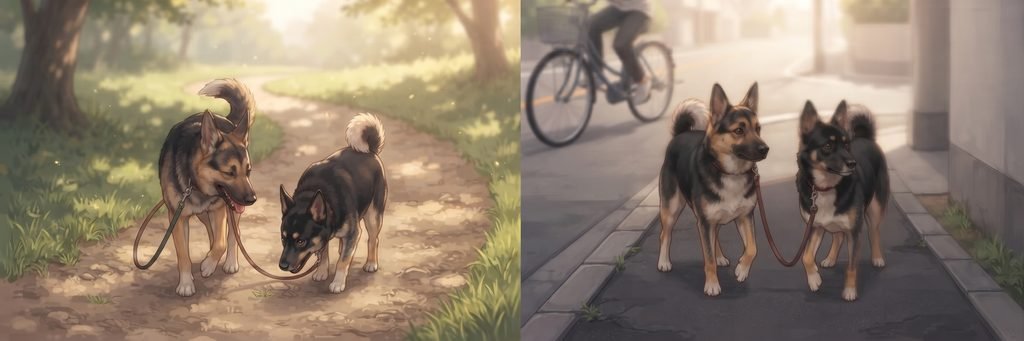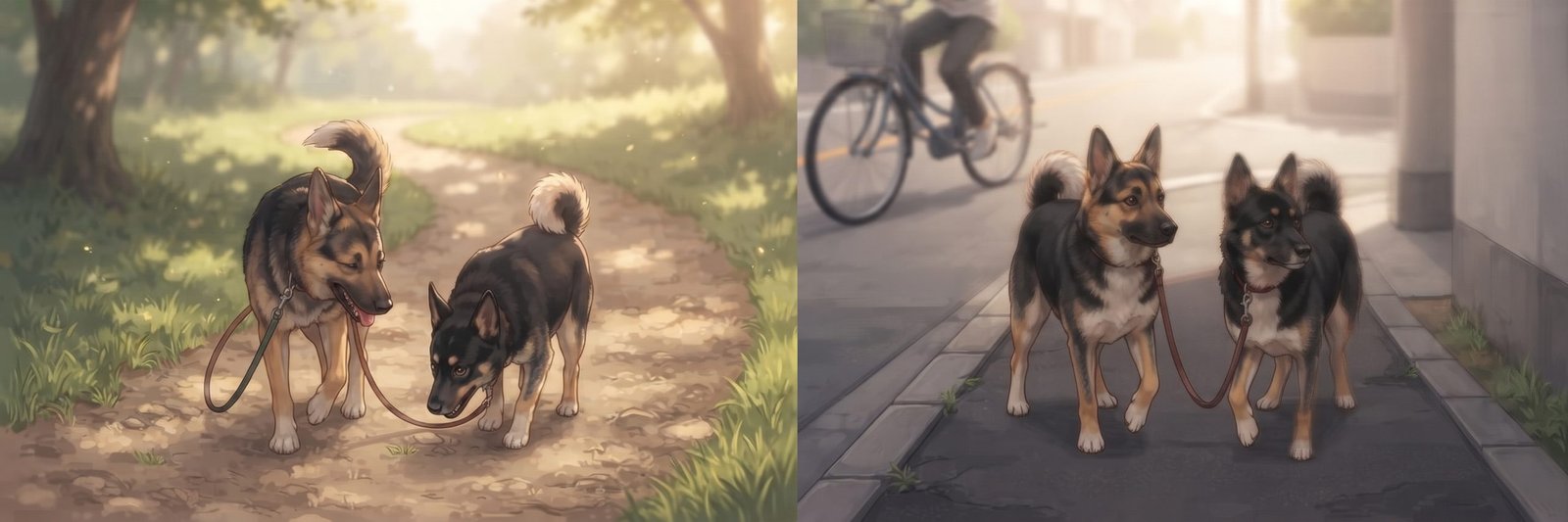
If your dog pulls hard on the leash or keeps panting long after returning home—even on a daily walk at the same hour—switching to a low-stress dog walking route can make an immediate difference, as the issue is often sensory density rather than walk duration. For dogs, walking is not merely physical exercise; it is a neurological decompression process driven by scent exploration and environmental awareness.
In our household, Hara and Lira are both energetic dogs, yet walking along straight, traffic-adjacent sidewalks regularly triggered alertness toward passing scooters and oncoming pedestrians. By keeping our total walking time unchanged and shifting just 30% of our route to a wider dirt trail and a quiet park perimeter, barking dropped noticeably and both dogs settled into deep sleep within fifteen minutes of coming home.
Why a Familiar Route Can Still Trigger Stress
To a human, walking the exact same block every day feels safe and predictable, but a dog’s sensory system processes that space very differently. High-traffic residential corridors and narrow sidewalks can keep a dog’s sympathetic nervous system locked in alert mode.
How Trigger Stacking Builds Up on Walks
When a dog encounters bicycles, delivery scooters, unfamiliar dogs, and sudden alley noises back-to-back during a single walk, cortisol levels do not have time to baseline. Behaviorists call this “trigger stacking,” which explains why a dog may suddenly bark or lunge at a minor sound near the end of a routine walk.
- Narrow Sidewalks: When there is no room to arc away from oncoming triggers, a dog loses spatial choice and tension spikes.
- Visual and Auditory Overload: Continuous traffic noise, reflections, and store doors opening make sustained sniffing nearly impossible.
- Patrol Mindset: Walking the exact same tight perimeter every day often shifts a dog from relaxed foraging into repetitive boundary patrolling.
Observing Hara and Lira Before and After Route Adjustments
Hara, with a larger shepherd-mix build, tended to stiffen at blind alley corners, while smaller, sound-sensitive Lira picked up on Hara’s posture and quickened her pace. On our old sidewalk-heavy loop, leash tension climbed during the second half of the walk, and neither dog spent more than ten seconds sniffing any single spot.
The quality of a dog walk is measured not by distance or step count, but by how much time your dog spends lowering their head and voluntarily sniffing at their own pace.
| Comparison Factor | Previous Straight Urban Loop | Adjusted Decompression Route |
| Primary Surface | Asphalt and narrow concrete sidewalks | Dirt paths, grass edges, wide walkways |
| Trigger Frequency | Passing pedestrians/vehicles every 1–2 minutes | Open sightlines allowing 10m+ advance notice |
| Average Sniffing Duration | 3–5 seconds per spot (rushed, shallow) | 15–30+ seconds per spot (slow breathing) |
| Post-Walk Behavior | Pacing and door-watching after drinking water | Relaxed sleep on individual mats within 15 minutes |
4 Practical Steps to Redesign a Low-Stress Dog Walking Route
You do not need to drive across town for every walk. Adjusting just the first five minutes after leaving your front door and the final five minutes before returning can flatten your dog’s arousal curve.
Step 1: Create a 5-Minute Decompression Start
If your front door opens near a busy road, spend the first five minutes heading toward a quiet side street, tree-lined median, or greenbelt. Starting a walk in high arousal makes it much harder for a dog to settle during the rest of the outing.
- For the first three minutes out the door, pause patiently while your dog investigates the very first scent patch instead of rushing forward.
- Use a relaxed 1.5 to 2-meter (5 to 6-foot) leash so there is no constant neck or chest pressure.
- When walking two dogs together like Hara and Lira, match your pace so neither dog is dragged away while the other is still sniffing.
Step 2: Choose Paths with Space for U-Shaped Arcs
Include walkways wide enough to step off to the side and create a 2 to 3-meter (6 to 10-foot) curved buffer when passing people or other dogs. Head-on passes on tight sidewalks create unavoidable social pressure.
- Prioritize park outer loops or wide greenway paths over narrow commercial sidewalks.
- Position yourself calmly between your dog and an approaching trigger to act as a visual buffer.
- Right after passing a trigger calmly, scatter a few pieces of kibble in the grass so your dog lowers their head and releases tension.
Step 3: Blend Three or More Ground Textures
Routes that combine dirt, fallen leaves, grass verges, and wooden boardwalks stimulate proprioceptive feedback through a dog’s paws far better than uniform asphalt. Changing surfaces naturally encourages dogs to slow down and focus on ground scents.
Step 4: Rotate 30% of the Route Two to Three Times a Week
Completely unfamiliar environments can overwhelm sensitive dogs, so keeping 70% of your familiar path while turning down a quieter parallel block for the remaining 30% builds a sustainable low-stress dog walking route that balances security and novelty.
Multi-Dog Walking Checklist for Harmonious Outings
When walking two dogs with different sizes and strides like Hara and Lira, small adjustments prevent one dog’s stress cues from cascading to the other.
- Schedule Solo Sniff Walks: Once or twice a week, take Hara and Lira on separate 15-minute solo walks to honor each dog’s natural pace and scent preferences.
- Hydration and Pacing Breaks: Longer sniffing sessions alter breathing rhythms, so carry water and pause in shaded, low-traffic spots.
- Calm Return Routine: Pair paw wiping at the entryway with a calm treat scatter so every walk ends on a grounded, predictable note.
Frequently Asked Questions (FAQ)
Q1. My dog stops and refuses to walk when we try a new path. What should I do?
Pausing to process new scent layers is healthy mental work, not stubbornness. Wait quietly for ten to twenty seconds without pulling the leash; if you notice fear cues like a tucked tail or pinned ears, calmly step back one block toward familiar ground to rebuild confidence.
Q2. How can I prevent stress buildup on rainy or poor air-quality days when we cannot take our usual route?
Shorten outdoor time to a ten-minute potty break and substitute indoor scent games—such as kibble hidden in rolled towels or cardboard boxes—alongside a soothing lick mat to provide equivalent mental decompression.
Q3. How long should a daily dog walk be?
While ideal duration varies by age, breed, and joint health, most adult dogs do well with two walks a day lasting 20 to 40 minutes each. Focus less on the clock and more on ensuring your dog has unhurried moments with a closed, relaxed mouth and active nosework.
Actionable Steps for Your Next Walk
On tonight’s walk, test a low-stress dog walking route by turning just one block away from your usual main street onto a quieter tree-lined path or park edge. Instead of aiming for distance, pause silently for fifteen seconds every time your dog stops to sniff—you will likely notice a calmer, more settled household the moment you step back inside.
Meta Description: Discover how tweaking 30% of your dog’s walking route lowers cortisol stress, illustrated through Hara and Lira’s real-world decompression routine.