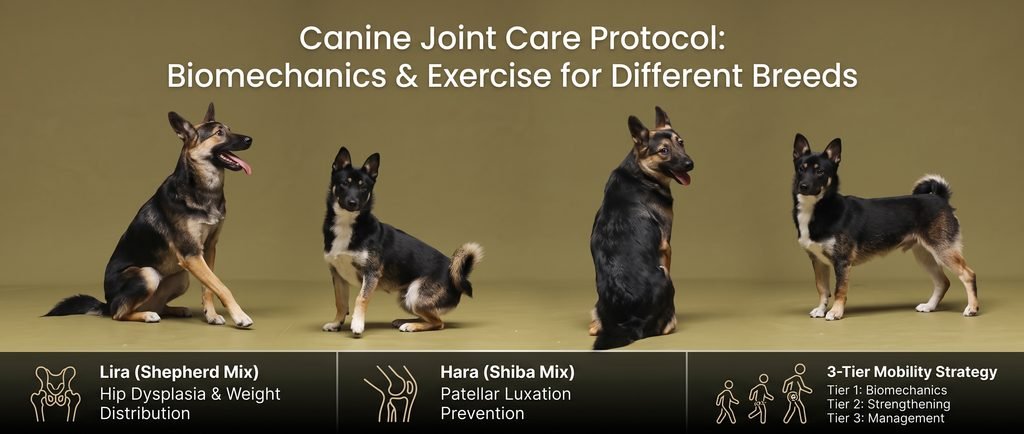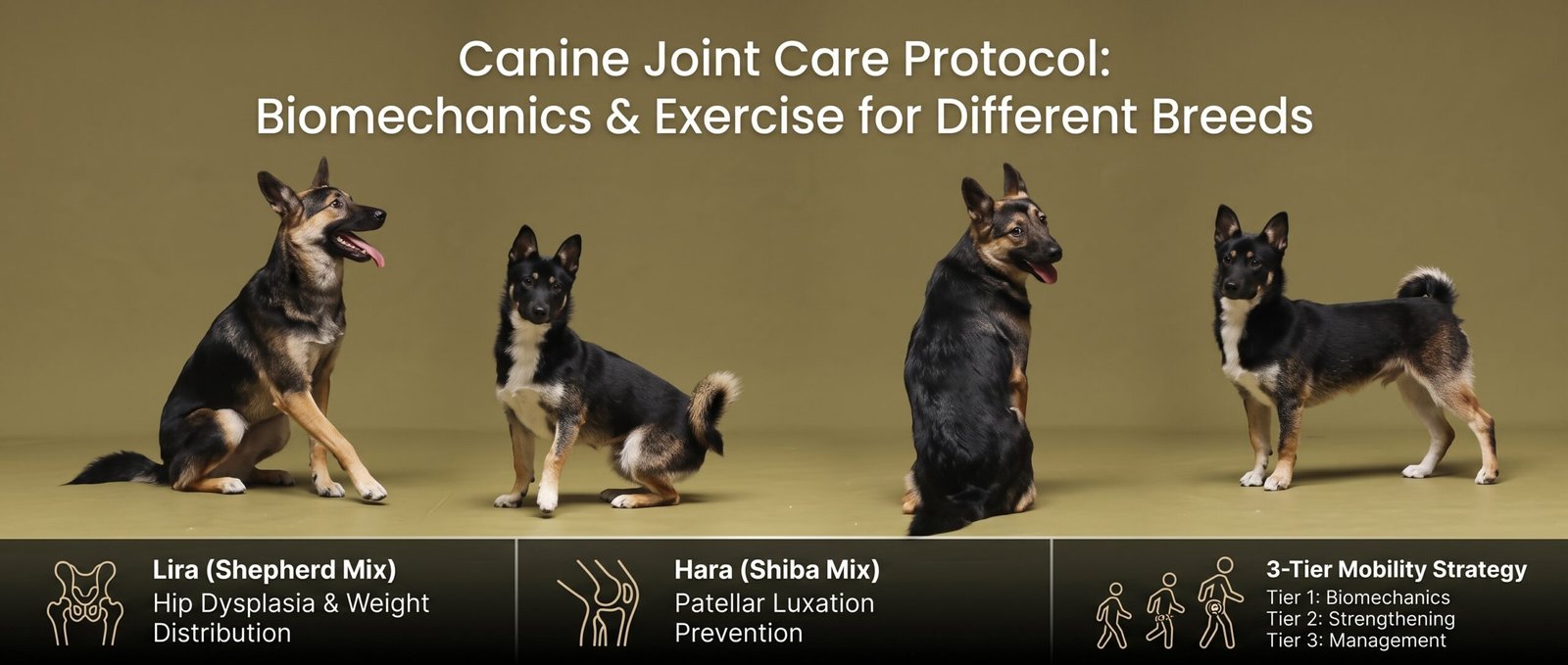
Understanding canine joint biomechanics reveals why canine lameness and difficulty rising do not emerge until over 30% of articular cartilage has already undergone irreversible degradation. Evolutionary instincts compel canines to suppress overt signs of orthopedic pain, making early micro-inflammatory processes difficult to observe with the naked eye. True orthopedic longevity relies not on post-symptomatic supplementation, but on proactive biomechanical load distribution tailored to specific skeletal typologies. The musculoskeletal stressors of a large-frame Shepherd mix like Lira differ fundamentally from those of a compact, agile Shiba mix like Hara. This guide provides a clinical evaluation of skeletal load vectors and delivers an evidence-based management protocol for optimal joint longevity.
1. Canine Joint Biomechanics and Vulnerability Profiles: Lira (Shepherd Mix) vs. Hara (Shiba Mix)
A dog’s body mass index and pelvic-to-limb angulation dictate the exact vector forces exerted on articular cartilage surfaces. Subjecting diverse breeds to uniform, high-impact exercise routines accelerates mechanical breakdown.
[Biomechanical Load & Orthopedic Susceptibility by Breed Class]

  ● Lira (Large Shepherd Mix)
    - Primary Load Axis: Coxofemoral (Hip) & Cubital (Elbow) Joints
    - Pathophysiological Risks: Acetabular subluxation, Canine Hip Dysplasia (CHD)
    - High-Risk Scenarios: Downhill deceleration, sudden braking torques

  ● Hara (Medium Shiba Mix)
    - Primary Load Axis: Stifle (Knee) Joint & Patellofemoral Groove
    - Pathophysiological Risks: Shallow trochlear groove, Medial Patellar Luxation (MPL)
[https://www.acvs.org/small-animal/canine-hip-dysplasia][https://www.acvs.org/small-animal/patellar-luxations]
    - High-Risk Scenarios: Bipedal standing, sudden lateral pivoting
Lira’s Dynamics: Coxofemoral Shear and Cranial Cruciate Strain
German Shepherd lineages typically present with sloping pelvic angles, placing approximately 60% of static weight on the thoracic limbs. For a large Shepherd mix like Lira, running generates ground reaction forces reaching 2.5 to 3 times her body weight, concentrating mechanical stress across the femoral head and acetabulum. For every single kilogram of excess weight, the biomechanical load across the hip joints quadruples during locomotion, underscoring the absolute necessity of strict weight regulation to prevent secondary osteoarthritis.
Hara’s Dynamics: Trochlear Hypoplasia and Patellar Instability
Conversely, spitz-type breeds such as the Shiba mix Hara often share an anatomical predisposition toward a shallow femoral trochlear groove. When torsional forces cause internal tibial rotation upon landing, the patella slips out of its physiological track, precipitating Grade 1 or 2 Medial Patellar Luxation (MPL). For Hara, maintaining dynamic stabilization through targeted strengthening of the quadriceps and hamstring complexes is vital to secure the stifle joint.
2. The 3-Tier Kinetic Control Protocol for Joint Preservation
Repetitive high-velocity ball-retrieval creates catastrophic shear stresses across articular cartilage. Applying practical canine joint biomechanics through a structured low-impact kinetic framework facilitates synovial fluid circulation while reinforcing stabilizing musculature.
| Training Tier | Protocol Specifics | Recommended Duration | Targeted Biomechanical Benefits |
| Tier 1: Isometric Warm-Up (Flat Cadence Walking) | Low-speed leash walking (3–4 km/h) on level ground | 10–15 Minutes | Stimulates synovial fluid synthesis and chondrocyte perfusion |
| Tier 2: Low-Grade Incline (Proprioceptive Loading) | Controlled walking up a 5–8 degree natural dirt/grass incline | 10 Minutes | Concentric hypertrophy of gluteal & hamstring groups |
| Tier 3: Cool-Down & PROM Therapy | Lateral recumbency: gentle, guided passive range of motion | 3 Minutes per limb | Prevents capsular contracture and accelerates lactic clearance |
Critical Safety Rule:
Downhill sprints, uncontrolled 180-degree turns, and indoor hardwood floor landings multiply joint shear forces fourfold. Indoor high-traffic pathways must be lined with shock-absorbing runners possessing a static coefficient of friction of at least 0.6.
3. Targeted Matrix Nutrition and Anti-Inflammatory Thresholds
Indiscriminate multi-supplement administration often leads to intestinal competitive absorption, rendering active fractions ineffective. Formulations must prioritize molecular weights and therapeutic concentration thresholds.
Glucosamine Hydrochloride to Low-Molecular-Weight Chondroitin Ratios
To upregulate proteoglycan synthesis within the extracellular cartilage matrix, administer glucosamine hydrochloride and chondroitin sulfate in an optimal 5:4 stoichiometric ratio. Only low-molecular-weight raw materials (under 10,000 Daltons) cross the intestinal epithelial barrier efficiently enough to diffuse into avascular articular cartilage.
Therapeutic Omega-3 (EPA/DHA) Anti-Inflammatory Thresholds
For bona fide suppression of synovial micro-inflammation, provide a daily clinical dose of 100 to 150 mg of combined EPA and DHA per kilogram of body weight. At this concentration, eicosapentaenoic acid systematically displaces membrane arachidonic acid, suppressing downstream production of pro-inflammatory 4-series leukotrienes and prostaglandin E2 at the cellular level.
Frequently Asked Questions (FAQ)
Q1. Should joint supplements be reserved until a dog exhibits noticeable stiffness?
No. Articular cartilage is completely devoid of vascularization and innervation. The moment clinical lameness or hesitation is visible, significant matrix erosion has already occurred. From the perspective of canine joint biomechanics, preventative supplementation should initiate at skeletal maturity: roughly 12 months for large-frame dogs like Lira, and 8 months for medium breeds like Hara.
Q2. How do stairs affect canine joint biomechanics and mobility?
Ascending stairs provides positive concentric engagement for rear-limb quadriceps. However, descending stairs introduces severe vertical concussion across the thoracic limbs and spine, exceeding twice the dog’s body weight. For chronic joint preservation, replace indoor stairs with ramps or manually support the dog.
Q3. How should caloric restriction be managed without inducing muscle wasting?
Slashing baseline kibble portions triggers catabolic muscle loss, destabilizing joint support. Transition to a veterinary high-protein, calorie-restricted formula supplemented with L-carnitine. Eliminate non-nutritive commercial treats and reduce daily caloric intake by a measured 15%.
Canine joint longevity cannot be purchased in a bottle. A comprehensive mastery of canine joint biomechanics—combining rigid weight control to relieve coxofemoral load with dynamic muscle conditioning—provides the definitive blueprint for pain-free senior years.
- Meta Description: Explore canine joint biomechanics and discover a 3-tier exercise and nutrition protocol designed to prevent hip dysplasia and patellar luxation in Shepherd and Shiba mixes.