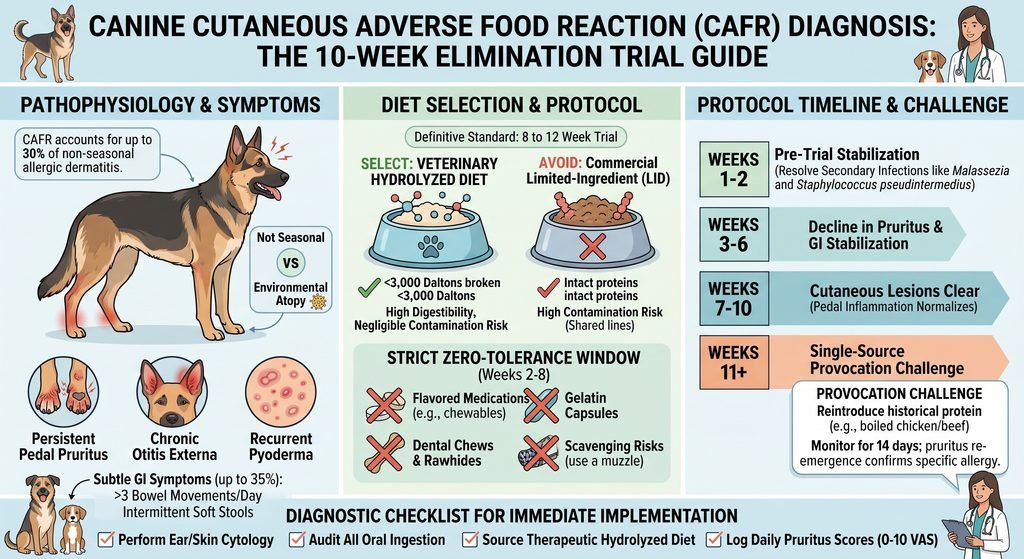
Conducting a strict dietary elimination trial for dogs is essential when persistent pedal pruritus, chronic bilateral otitis externa, and recurrent superficial pyoderma fail to respond to standard therapy. While these symptoms in dogs are frequently misdiagnosed as simple seasonal allergies, they may represent cutaneous adverse food reactions (CAFR). In clinical reality, CAFR accounts for up to 30% of all non-seasonal allergic dermatitis cases in companion canines. Unlike environmental atopy, food hypersensitivity cannot be resolved with topical corticosteroids or antihistamines alone. Achieving permanent clinical remission demands an uncompromised, methodically executed dietary elimination trial lasting 8 to 12 weeks.
1. Pathophysiology: True Food Allergy vs. Dietary Indiscretion
Immunological Mechanisms of Cutaneous Adverse Reactions
True canine food allergy is an adverse reaction involving immune-mediated hypersensitivity—predominantly Type I (IgE-mediated immediate hypersensitivity) and Type IV (cell-mediated delayed hypersensitivity). When a canine with genetic susceptibility is repeatedly exposed to intact glycoproteins ranging between 10 and 70 kilodaltons (kDa)—most commonly bovine proteins, chicken, dairy, wheat, or soy—intestinal mucosal permeability allows these macromolecular antigens to cross the gut-associated lymphoid tissue (GALT), triggering systemic sensitization.
Differentiating CAFR from Canine Atopic Dermatitis (CAD)
While clinical presentations overlap significantly, specific phenotypic markers distinguish food hypersensitivity from environmental atopy:
- Age of Onset: Food allergies frequently manifest either very early (under 1 year of age) or later in adult life (over 6 years), whereas environmental atopy typically surfaces between 1 and 3 years.
- Non-Seasonal Persistence: Symptoms do not ebb and flow with pollen seasons, relative humidity, or winter heating cycles; the pruritus remains unyielding year-round.
- Concurrent Gastrointestinal Pathology: Up to 35% of canines with CAFR exhibit subtle gastrointestinal disturbances, including more than three bowel movements daily, intermittent soft stools, borborygmi, or subclinical tenesmus.
Veterinary Diagnostic Rule: Serological allergen blood tests (serum IgE/IgG panels) and intradermal skin tests for food allergens show high rates of false-positive and false-negative outcomes. An elimination trial using a hydrolyzed or novel single-protein diet remains the definitive diagnostic gold standard.
2. Hydrolyzed vs. Novel Protein Diets: Comparative Matrix
Selecting an appropriate diet is the pivotal variable in a successful diagnostic outcome. Commercial over-the-counter “grain-free” or “limited ingredient” formulas consistently fail clinical standards due to industrial cross-contamination on manufacturing lines.
| Criteria | Veterinary Hydrolyzed Diet | Home-Cooked Novel Protein Diet | Commercial Limited-Ingredient (LID) |
| Protein Processing | Enzymatically cleaved (<3,000 Daltons) | Intact, single novel source (e.g., Venison, Rabbit) | Variable intact proteins |
| Cross-Contamination Risk | Negligible (dedicated production facilities) | Zero (strict single-kitchen control) | High (shared equipment with chicken/beef lines) |
| Gastrointestinal Digestibility | Exceeds 90%; minimal mucosal stress | High, provided fiber balance is maintained | Moderate to Poor depending on fillers |
| Suitability for Long-term Use | Meets complete AAFCO/FEDIAF profiles | Requires certified veterinary nutritionist formulation | Often nutritionally unbalanced |
| Diagnostic Reliability | Highest (eliminates molecular recognition) | High (if protein exposure history is accurate) | Unreliable for diagnostic trials |
3. The 10-Week Dietary Elimination Trial for Dogs: Execution and Compliance
Diagnostic failure during an elimination diet is almost universally attributable to owner compliance breakdown rather than diet formulation failure. Even a fraction of a gram of an offending antigen will reset the gastrointestinal immunological cascade.
+---------------------------------------------------------------------------------+
|                               ELIMINATION DIET TIMELINE                          |
+---------------------------------------------------------------------------------+
| Weeks 1–2  : Transition phase; resolve secondary bacterial/yeast infections     |
| Weeks 3–6  : Baseline pruritus begins to decline; gut barrier stabilizes        |
| Weeks 7–10 : Cutaneous lesions clear; pedal inflammation normalizes             |
| Weeks 11+  : Controlled Single-Source Provocation Challenge                     |
+---------------------------------------------------------------------------------+
Phase 1: Pre-Trial Stabilization (Days 1–7)
Before the trial commences, secondary opportunistic infections must be addressed. Cytology of the paws, ventral abdomen, and ear canals should identify any overgrowth of Staphylococcus pseudintermedius or Malassezia pachydermatis. Active micro-organisms produce exogenous pruritogens that mimic persistent food allergy. Transition the patient gradually over 5 days from the previous diet to the exclusive elimination formula.
Phase 2: The Strict Zero-Tolerance Window (Weeks 2–8)
During this period, the canine must ingest solely the designated therapeutic diet and pure water. The following hidden antigens must be eliminated:
- Flavored Medications: Chewable heartworm and tick preventative tablets containing artificial beef or pork liver flavoring must be switched to topical alternatives or non-flavored oral tablets.
- Gelatin Capsules: Common veterinary supplements encased in bovine gelatin must be discontinued.
- Dental Chews and Rawhides: Strictly prohibited. Toothbrushing should be performed using mechanical water brushing or unflavored, hypoallergenic enzymatic pastes.
- Scavenging Risks: Muzzle training during outdoor walks is mandatory if the dog exhibits coprophagia or scavenger tendencies.
Phase 3: The Provocation Challenge (Weeks 9–10)
A dog cannot be diagnosed with CAFR based solely on improvement; remission could coincide with an environmental shift. To confirm the diagnosis:
- Reintroduce a single pure protein from the historical diet (e.g., boiled chicken breast or unseasoned beef) as 25% of daily calories alongside the therapeutic food.
- Monitor closely for 14 consecutive days. If pruritus, erythema, or otic discharge re-emerges within 48 to 72 hours, CAFR to that specific protein is clinically confirmed.
- Immediately revert to the base elimination diet until full quiescence is achieved before testing another candidate ingredient.
4. Case Application: Active Shepherd Mixes (Hara & Lira)
When conducting dietary protocols on high-energy mixed breeds—such as shepherd mixes like Hara (displaying athletic structure and high metabolic output) and companion mixes like Lira (requiring lean mass maintenance)—caloric density and protein quality become acute priorities.
- Preventing Muscle Catabolism: Hydrolyzed diets often have lower crude protein percentages. For active dogs, calculate the Daily Energy Requirement (DER) accurately using the formula:
$$\text{RER} = 70 \times (\text{Body Weight in kg})^{0.75}$$$$\text{DER} = \text{RER} \times 1.6 \text{ to } 1.8 \text{ (for intact active working lines)}$$ - Managing Environmental Distractions: Highly motivated, intelligent working-type mixes frequently receive high-value food rewards during training. During the trial, dehydrate portions of the prescription wet canned food into crunchy training bites to maintain behavioral reinforcement without compromising antigenic control.
Frequently Asked Questions (FAQ)
Can I use store-bought salmon and sweet potato kibble instead of prescription hydrolyzed food?
No. Independent DNA and ELISA testing of commercial pet foods repeatedly demonstrates unlisted protein contamination. Shared extrusion lines in non-veterinary manufacturing facilities frequently introduce micro-quantities of avian or mammalian antigens capable of sustaining an allergic response.
How do I know if my dog’s ear infections are caused by food or ear mites?
Ear mites (Otodectes cynotis) cause acute, coffee-ground-like debris and are readily identified via direct microscopic examination. CAFR-related otitis externa manifests as ceruminous (waxy), yellowish, or erythematous inflammation of the vertical and horizontal ear canals, often recurring within weeks of topical treatment cessation.
Will dietary supplements like omega-3 fish oil interfere with an elimination trial?
Standard fish oil supplements derived from mixed marine sources often contain residual marine proteins that can provoke reactive canines. Use only pharmaceutical-grade, highly refined ethyl-ester omega-3 formulations or withhold fatty acid supplementation until the diagnostic challenge phase is complete.
Diagnostic Checklist for Immediate Implementation
- Conduct Ear and Skin Cytology: Rule out and treat active secondary Malassezia or Staphylococcal overgrowth before evaluating diet efficacy.
- Audit All Oral Ingestion: Replace flavored chewables, table scraps, flavored toys, and dental treats with zero-tolerance hypoallergenic protocols.
- Select Therapeutic Hydrolyzed Food: Source a clinically proven veterinary therapeutic diet Cleared of intact peptides.
- Log Daily Pruritus Scores: Record scratching, licking, and head-shaking behavior on a visual analog scale (0–10) weekly to objectively measure clinical trajectory.
- Meta Description: A complete clinical guide to diagnosing canine food allergies (CAFR) through strict 10-week elimination trials, hydrolyzed protein science, and dermatological protocols.