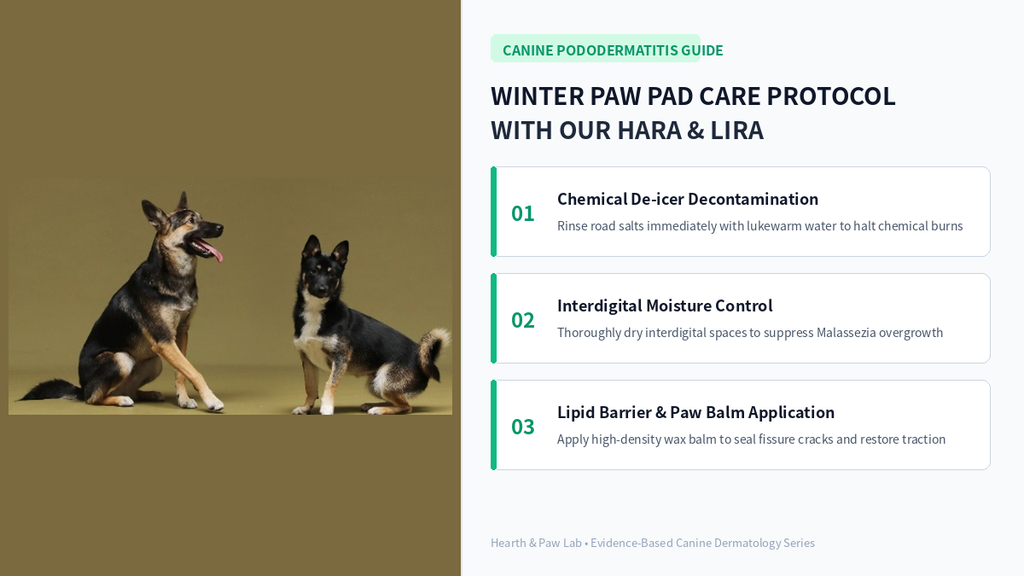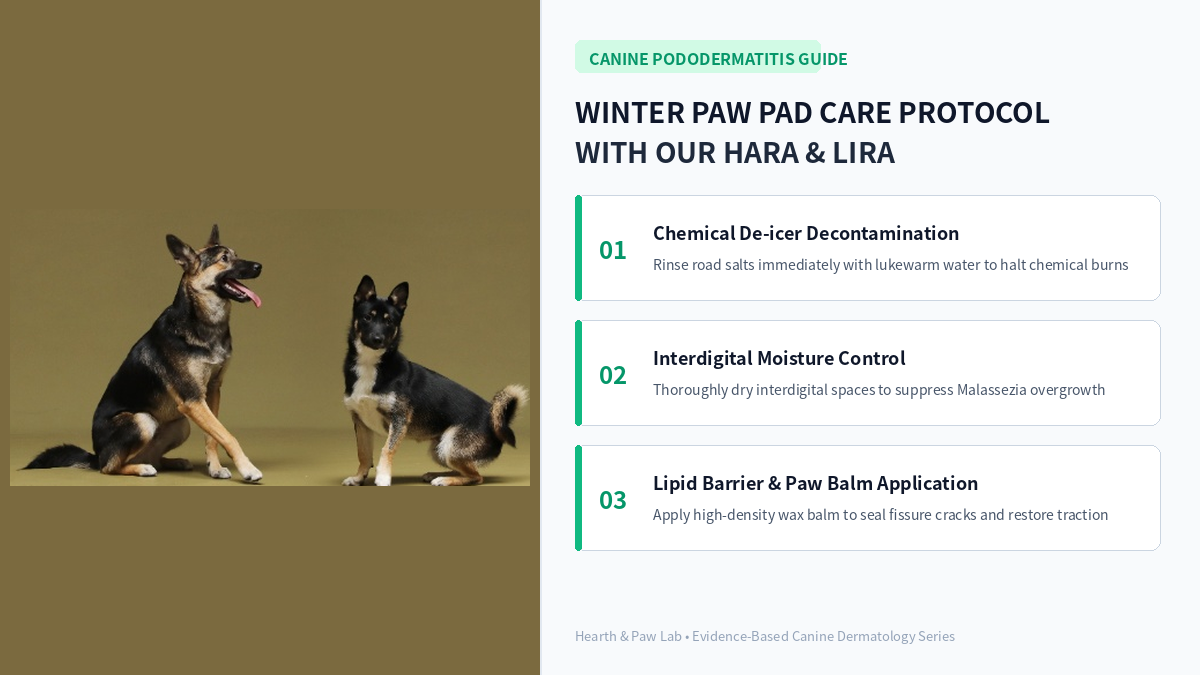
When managing dog winter paw care, observing a dog abruptly lift a paw or obsessively lick their feet signals acute chemical trauma and pododermatitis rather than mere cold intolerance. Road de-icers—predominantly calcium chloride and rock salts—exert severe chemical exfoliation and thermal burns on the canine stratum corneum. For heavy, highly athletic working breeds and mixed canines whose ground-impact force is substantial, unprotected exposure accelerates micro-fissuring and secondary microbial invasion.
1. Pathophysiological Threats of Winter Terrain
Exothermic Deliquescence and Chemical Exfoliation
Industrial de-icing salts operate via exothermic deliquescence: they rapidly pull ambient moisture to generate heat and liquefy ice. When embedded within canine digital pads, these caustic crystals strip natural intercellular lipids, inducing chemical ulcerations. Subsequent oral ingestion during grooming introduces systemic toxicity risks, ranging from severe mucosal stomatitis to hypercalcemia and gastroenteritis.
Mechanical Abrasion and Cryogenic Micro-Trauma
Jagged ice shards and crusted snow act as abrasive micro-blades, shearing through the keratinized epidermal barrier. Prolonged exposure to temperatures below -10°C triggers reflex vasoconstriction in digital capillary loops, predisposing the footpad margins to hypoperfusion, ischemic injury, and localized frostbite.
Veterinary Insight: Chronic erythema or rust-colored staining between the digits indicates secondary Malassezia pachydermatis yeast proliferation. Failing to thoroughly desiccate interdigital spaces post-walk fosters an incubator environment for deep pododermatitis.
2. Comparative Matrix: Winter Paw Protection Strategies
| Management Factor | High-Risk Traditional Approach | Evidence-Based Clinical Protocol | Expected Therapeutic Outcome |
| Pre-Walk Barrier | Plain petrolatum ointment | High-density beeswax/candelilla wax balm | Seals stratum corneum against chemical penetration |
| Protective Footwear | Non-breathable rubber socks | Ergonomic, treaded canine booties | Preserves proprioception while blocking ice impact |
| Post-Walk Cleansing | Aggressive wiping with dry paper/hot water | Lukewarm water immersion followed by micro-fiber drying | Eliminates chemical residue without inducing vasospasm |
3. Systematic 3-Phase Winter Paw Prophylaxis Protocol
Phase 1: Pre-Departure Desensitization and Wax Shielding
Overgrown interdigital hair promotes the accumulation of hard ice balls (“snowballs”), which mechanically force the toes apart and induce ligamentous strain during locomotion. Trim interdigital hair flush with the pad margin using a safety clipper. Generously massage a high-density natural beeswax balm into the footpads and webbing to establish a hydrophobic shield against saline slush.
Phase 2: Gait and Proprioception Monitoring
During walks, observe for signs of acute thermal distress: sudden deceleration, holding a limb elevated, or shivering while sitting. Never drag an uncomfortable dog forward. Immediately flush visible road salts with room-temperature bottled water, blot with a dry microfiber cloth, and curtail the excursion.
Phase 3: Immediate Post-Walk Decontamination
- Lukewarm Immersion Rinse: Submerge all four paws in lukewarm water (25–30°C) to dissolve crystallized salts. Avoid hot water, which exacerbates capillary inflammation.
- Complete Interdigital Desiccation: Blot thoroughly with a clean towel, then utilize a pet hair dryer on the ambient/cool setting until the interdigital folds are completely dry.
- Lipid Barrier Replenishment: Apply an unfragranced, ceramide-fortified veterinary paw lotion to replenish the compromised lipid bilayer.
Frequently Asked Questions (FAQ)
Q1. Is standard human petroleum jelly safe for canine footpads?
While petroleum jelly acts as an occlusive agent, it remains greasy, collects floor particulate, and acts as a mild laxative if ingested in significant volumes during grooming. Veterinary-formulated natural wax balms provide superior adherence and complete non-toxic safety upon licking.
Q2. My dog refuses to walk in boots. Are they strictly mandatory?
Forcing unconditioned dogs into rigid boots disrupts their normal joint angulation and natural biomechanics. If boots induce gait distress, applying a robust coat of wax barrier balm combined with avoiding heavily salted asphalt routes serves as an effective, low-stress alternative.
Your dog’s paw pads are their sole biomechanical shock absorbers. Implementing a rigorous three-minute post-walk regimen—lukewarm immersion rinsing, complete interdigital drying, and lipid barrier restoration—prevents over 95% of seasonal chemical burns and debilitating pododermatitis.
- Meta Description: A clinical guide to winter canine paw care: preventing chemical burns from de-icing salts, treating pododermatitis, and step-by-step protective wax protocols.